

When consultants need customer insights, the default answer has been surveys for decades. SurveyMonkey perfected the formula: design questions, distribute links, collect hundreds of responses, and analyze the numbers. It’s fast, scalable, and statistically sound.
But here’s the challenge consultants increasingly face: surveys tell you what customers prefer, but struggle to reveal why they make decisions. When a strategy consultant needs to understand what’s blocking market adoption, or a GTM consultant needs to validate messaging resonance before launch, checkbox answers rarely provide the depth needed.
This creates a methodological gap: quantitative validation (surveys excel here) versus qualitative exploration (where conversational depth matters more than sample size). SurveyMonkey wasn’t designed for the second scenario—and that’s where Atypica positions itself as a complementary research approach for consultants who need both.
Core Methodology Comparison
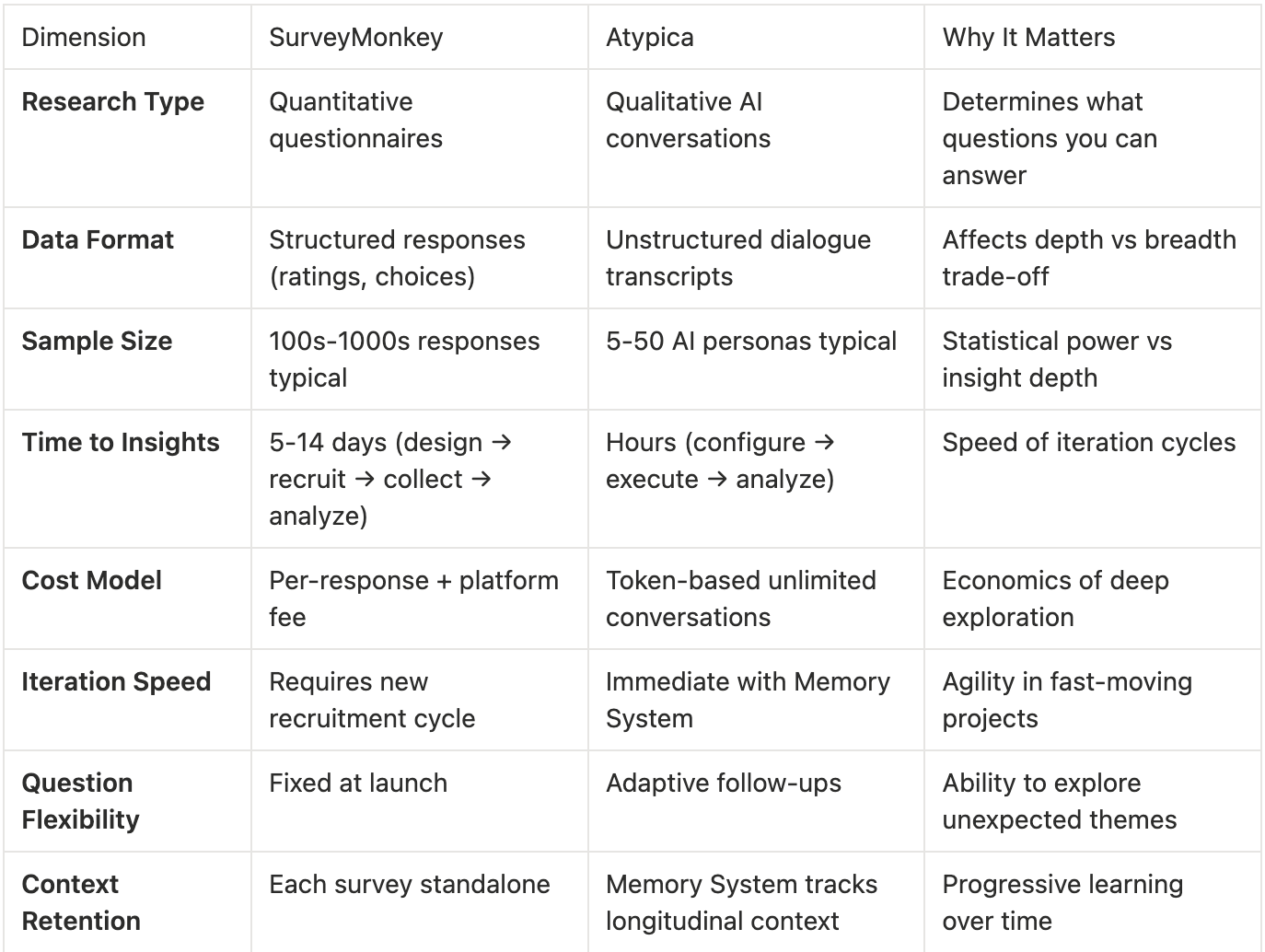
The fundamental difference: SurveyMonkey measures distribution across known variables. Atypica explores unknown decision factors through conversation.
SurveyMonkey: Quantitative Validation at Scale
Core Strengths
What SurveyMonkey does exceptionally well:
Statistical Validation - When you need to prove that 68% of enterprise buyers prefer feature A over B with 95% confidence, surveys provide the mathematical rigor.
Demographic Segmentation - “How do preferences differ by company size, industry, and role?” requires large samples that only survey panels can deliver efficiently.
Metric Tracking - NPS scores, satisfaction ratings, and awareness metrics tracked quarterly across consistent cohorts.
Known Answer Spaces - “Which of these five pricing models would you choose?” works when options are predefined.
Current Capabilities (2026)
Pricing Structure:
Standard Monthly: $99/month, unlimited surveys and questions, 1,000 responses/month
Advantage Annual: $39/month when billed annually ($468/year), 15,000 responses/year
Premier Annual: $139/month when billed annually ($1,668/year), 40,000 responses/year
Panel Recruitment (SurveyMonkey Audience): Starting at $1 per response (pricing varies based on target audience complexity and survey length)
Advanced Features:
AI-powered survey generation from prompts
Logic branching and skip patterns
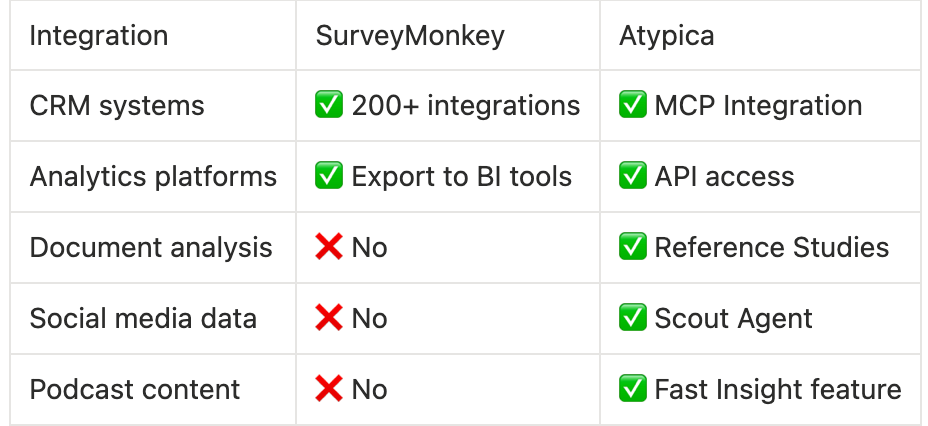
200+ integrations (Slack, HubSpot, Mailchimp)
Real-time analytics and automated charting
Advanced methods: MaxDiff, TURF Analysis, Conjoint, Price Optimization
Custom branding and white-label URLs
Limitations Consultants Encounter
Response Rate Reality:
Email distribution: 2-10% typical response rate
Need to reach 5,000 people to get 250 completions
Senior executives and technical specialists have <5% response rates
Depth Constraints:
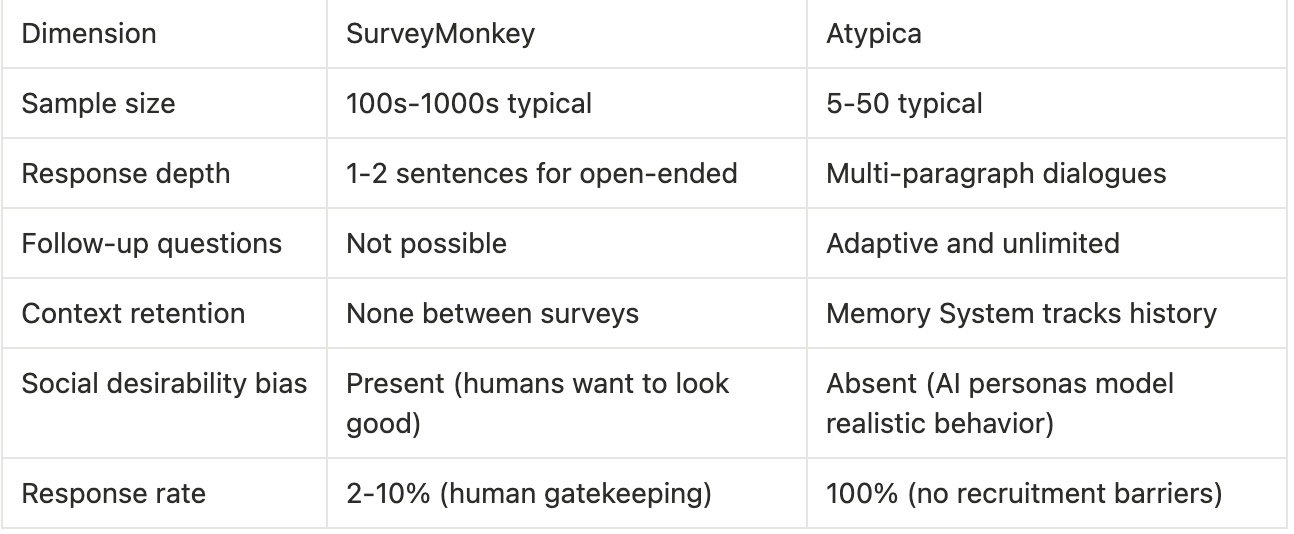
Open-ended questions yield 1-2 sentence answers
Cannot probe: “You said X, can you explain what you meant?”
Social desirability bias affects candid responses
Respondent fatigue limits question count
Timing Challenges:
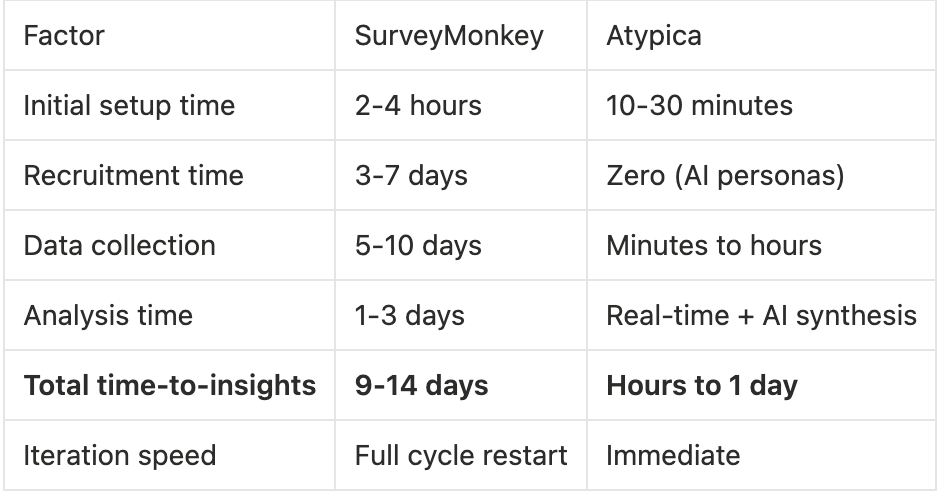
Design survey: 2-4 hours
Panel recruitment: 3-7 days
Collection period: 5-10 days for adequate sample
Analysis: 1-3 days
Total: 9-14 days per iteration
Real consultant scenario: A brand consultant testing three positioning concepts for a B2B SaaS client. SurveyMonkey can measure which concept scores highest on a 1-7 scale across 500 respondents. But when stakeholders ask “Why did concept B resonate with IT buyers but fail with business users?” The survey data goes silent.
Atypica: Conversational Research for Qualitative Depth
Core Strengths
What Atypica does differently:
Exploratory Conversations - AI Interview mode conducts multi-turn dialogues that adapt based on responses, uncovering motivations surveys can’t surface.
Behavioral Context - Scout Agent observes social media to understand target audiences’ lifestyles, values, and mindsets—the “why” behind stated preferences.
Rapid Iteration - Test new concepts, messaging, or positioning in hours, not weeks. No recruitment delays.
Cost-Effective Depth - Token-based pricing eliminates per-response fees, making 50-conversation deep dives economically viable.
Current Capabilities (2026)
Pricing Structure:
Pro: $20/month, 2M tokens/month
Max: $50/month, 5M tokens/month
Super: $200/month, unlimited tokens
Core Features:
AI Interview Mode: Multi-turn conversational research with adaptive follow-ups
Scout Agent: Social media observation for lifestyle and behavioral context
Three-Tier Persona System: Based on consistency science for reliable behavioral modeling
Memory System: Retains context across sessions for longitudinal research
Plan Mode: Auto-structures research approach before execution
Fast Insight: Converts research to podcast-style content in hours
MCP Integration: Connects to enterprise data sources (CRM, analytics, support tickets)
Reference Studies: Analyzes documents and files for contextual depth
Quantified Advantages
Time Savings:
Traditional human interviews: 2-3 weeks recruitment + 1-2 weeks scheduling
Atypica: Hours from concept to insights
87% faster time-to-insights compared to traditional qualitative research
Cost Savings:
Human research panels: $75-150 per 45-minute interview
50 interviews = $3,750-7,500
Atypica: $129-899/month unlimited interviews
80-85% cost reduction for deep qualitative research
Iteration Speed:
Survey re-deployment: 7-14 days
Atypica iteration: Immediate (Memory System retains prior context)
Limitations to Acknowledge
What Atypica isn’t designed for:
Statistical Validation - AI personas provide directional insights, not statistical proof for board presentations requiring p-values.
Demographic Quotas - Cannot deliver “exactly 100 responses from healthcare CMOs in EMEA with $50M+ budgets.”
Regulatory Compliance - Industries requiring documented human consent (pharmaceutical trials, clinical research) cannot use AI-simulated responses.
Final Pricing Research - Van Westendorp analysis and conjoint studies requiring large samples need real buyer responses.
Multi-Dimensional Comparison Framework
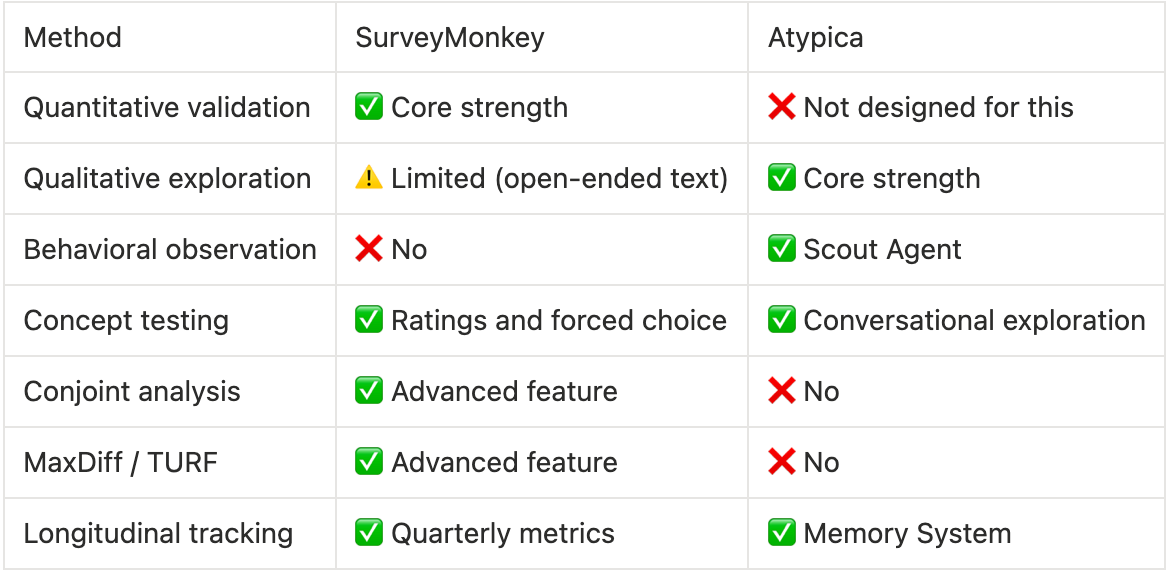
1. Research Method Coverage
2. Speed & Agility
3. Cost Structure

Break-even analysis: For consultants running >5 research projects per month, Atypica’s unlimited model becomes more economical than per-response pricing.
4. Data Quality & Depth
5. Integration & Workflow
Scenario-Based Decision Framework
Choose SurveyMonkey when:
✅ You need statistical validation for stakeholder buy-in
“We surveyed 500 customers and 73% prefer the new pricing model (p<0.05)”
Board presentations requiring quantitative proof
✅ Demographic segmentation is critical
“How do preferences differ by: enterprise vs SMB, technical vs business buyer, North America vs EMEA?”
Requires large sample sizes with quota controls
✅ Tracking metrics over time
Quarterly NPS scores
Brand awareness tracking
Customer satisfaction benchmarking
✅ Known answer options
“Which of these five features would you use most?”
“Rate importance of X on 1-7 scale”
✅ Compliance requirements
Healthcare, pharmaceutical, clinical research
Documented human consent needed
Regulatory audits require real respondent data
Choose Atypica when:
✅ Exploring unknown decision factors
“What’s preventing enterprise adoption?” (you don’t know the barriers yet)
“Why do users abandon onboarding at step 3?” (need to uncover reasons)
✅ Testing concepts before building
Validate messaging positioning with 20 personas in 2 hours
Iterate three positioning variations same day based on feedback
No recruitment delay for early-stage exploration
✅ Understanding behavioral context
Scout Agent reveals what target users discuss on Reddit, LinkedIn, industry forums
Lifestyle and values context surveys cannot capture
✅ Rapid iteration cycles
Weekly research sprints aligned with product development
A/B test messaging variations within hours
Pivot strategy based on yesterday’s insights
✅ Budget constraints for deep research
Traditional 50-interview qualitative study: $5,000-10,000
Atypica unlimited interviews: $129-899/month
80-85% cost savings for exploratory depth
✅ Low response rate challenges
Reaching senior executives, technical specialists, or niche industries
Survey fatigue in over-surveyed segments
AI personas provide 100% “participation”
Use both strategically when:
✅ Comprehensive product launches
Atypica for concept testing and messaging development (Week 1-2)
SurveyMonkey for quantitative validation and market sizing (Week 3-4)
✅ Continuous improvement programs
SurveyMonkey for quarterly metric tracking
Atypica for investigating unexpected drops or emerging themes
Qualitative explains quantitative patterns
✅ GTM strategy development
Atypica explores positioning resonance with 30 personas
SurveyMonkey validates top 2-3 approaches with 500 buyers
Confidence from both depth and statistical validation
Real-World Application: Case Study
Scenario: B2B SaaS Repositioning Project
Client: Enterprise collaboration platform targeting IT buyers
Challenge: Declining trial-to-paid conversion (32% → 19% over 6 months)
Timeline: 3 weeks
Budget: $15,000 research allocation
Phase 1: Exploration with Atypica (Week 1)
Research Design:
25 AI Interview conversations with CIO and IT Director personas
Scout Agent analysis of r/sysadmin, r/ITManagers, LinkedIn IT groups
Focus: “What concerns prevent enterprise tools trial-to-purchase?”
Key Findings (discovered through conversation):
Security compliance concerns (mentioned in 18/25 conversations)
“Our auditors require SOC 2 Type II before we can deploy”
Not listed on product website during trial
Integration complexity fears (16/25 conversations)
“We already have Slack, Teams, and Zoom—why add another tool?”
Unclear how product fits existing stack
ROI justification difficulty (14/25 conversations)
“I can’t explain to finance why we need this vs free alternatives”
Missing cost-benefit comparison tools
Time: 3 days (including analysis)
Cost: $329 Atypica Max plan
Phase 2: Quantitative Validation with SurveyMonkey (Week 2)
Survey Design:
Informed by Atypica insights, created targeted survey:
“Which factors prevent you from purchasing collaboration tools after trial?” (rank top 3)
Security certification concerns
Integration with existing tools
ROI justification difficulty
Pricing
Feature gaps
Other
“How important is SOC 2 Type II certification in your purchase decision?” (1-7 scale)
Demographics: company size, industry, role
Distribution:
2,500 panel invitations (IT decision-makers)
487 completed responses (19.5% response rate)
$2,193 panel cost + $468 Advantage annual plan
Results:
Security compliance: 62% ranked in top 3 concerns
Integration clarity: 58% ranked in top 3
ROI justification: 43% ranked in top 3
SOC 2 importance: Mean score 6.2/7 (enterprise segment)
Time: 10 days
Cost: $2,661
Phase 3: Iterative Refinement with Atypica (Week 3)
Using SurveyMonkey’s validated priorities, Atypica tested messaging variations:
Test 1: Security-First Messaging
15 AI interviews testing: “Enterprise-grade security you can deploy in hours”
Feedback: Resonates but creates expectations about setup complexity
Test 2: Integration-First Messaging
15 AI interviews testing: “Works with your stack: Slack, Teams, Google Workspace”
Feedback: Strong interest, questions about specific integration capabilities
Test 3: ROI-First Messaging
15 AI interviews testing: “Reduce meeting time 40% = $847/employee annual savings”
Feedback: Highly compelling for business buyers, less relevant to IT
Final Recommendation: Lead with Integration-First (IT interest) → Security proof (IT requirement) → ROI calculator (business stakeholder buy-in)
Time: 2 days
Cost: Included in existing Atypica subscription
Total Project:
Timeline: 15 days (vs 6-8 weeks traditional approach)
Cost: $2,990 (vs $12,000-18,000 traditional qualitative + quantitative research)
Outcome: New messaging tested in production, conversion improved 19% → 27% within 6 weeks
Industry Trends: The Evolution of Research Methodology
From Project-Based to Continuous Research
Traditional Model (Survey-Centric):
Quarterly or annual “research projects”
6-8 week lead time makes research a special event
Research happens before decisions, then gets outdated
Expensive per-project costs limit frequency
Emerging Model (Hybrid Approach):
Weekly qualitative exploration (Atypica) informs product decisions in real-time
Quarterly quantitative validation (SurveyMonkey) tracks metrics and tests hypotheses
Research becomes continuous feedback loop, not periodic checkpoint
Economics enable “always-on” research culture
What’s changing: SaaS pricing models and AI capabilities make deep research economically viable at sprint cadence, not project cadence.
Democratization of Customer Insights
Traditional Barriers:
Only research teams had budget/skills for qualitative interviews
Product managers and consultants waited weeks for insights
“Customer-obsessed” culture limited by research bottlenecks
New Reality:
Consultants run their own exploratory research (Atypica)
Validate findings with panel surveys when needed (SurveyMonkey)
Research expertise shifts from “data collector” to “strategic interpreter”
Impact for consultants: Client projects no longer bottlenecked by research agency timelines. Run exploratory research Monday, present validated findings Friday.
The “Why” Behind the Metrics
Survey platforms tell consultants that NPS dropped from 45 to 38. Conversational AI explores *why*:
What changed in customer experience?
Which segment is most affected?
What would restore satisfaction?
The integration: Metrics identify problems (quantitative). Conversation uncovers solutions (qualitative).
Honest Strengths & Limitations Analysis
SurveyMonkey
Undeniable Strengths:
✅ Statistical rigor for stakeholder presentations
✅ Demographic segmentation at scale
✅ Proven methodology accepted across industries
✅ 200+ integrations with business tools
✅ Advanced analysis (MaxDiff, Conjoint, TURF)
Honest Limitations:
❌ 5-14 day iteration cycles
❌ $1-5 per response makes deep exploration expensive
❌ Open-ended questions yield shallow responses
❌ Cannot adapt questions based on previous answers
❌ Response rate challenges (2-10% typical)
❌ Social desirability bias affects candid responses
Atypica
Undeniable Strengths:
✅ Hours to insights (vs days/weeks)
✅ Unlimited iteration at fixed subscription cost
✅ Multi-turn conversational depth
✅ Scout Agent reveals behavioral context surveys miss
✅ Memory System enables longitudinal research
✅ 80-85% cost savings vs traditional qualitative research
✅ 100% participation (no recruitment barriers)
Honest Limitations:
❌ Cannot provide statistical validation for board-level decisions
❌ Not suitable for regulatory compliance documentation
❌ Cannot deliver demographic quotas (e.g., “exactly 100 healthcare CFOs”)
❌ Advanced quantitative methods (Conjoint, MaxDiff) not available
❌ Some stakeholders skeptical of AI-simulated research
❌ Requires expertise to design effective conversational research
FAQ
Q: Can Atypica replace SurveyMonkey entirely?
A: Not for most organizations. If you need statistical validation, demographic segmentation, or compliance documentation, SurveyMonkey’s quantitative approach remains essential. Atypica excels at qualitative exploration—understanding motivations, testing concepts conversationally, and rapid iteration.
Best practice: Use Atypica for exploration and concept development (fast, deep, cheap). Use SurveyMonkey for validation and measurement (statistically rigorous, demographically segmented).
Q: How accurate are AI personas compared to real survey respondents?
A: Atypica’s three-tier persona system models behavioral consistency based on psychographic and demographic patterns. For directional insights and *qualitative exploration*, AI conversations uncover themes and concerns that inform strategy.
For final validation requiring statistical confidence (e.g., “68% of buyers prefer A over B with p<0.05”), real human responses via SurveyMonkey remain necessary.
Mental model: AI personas = directional compass for exploration. Real respondents = GPS coordinates for validation.
Q: What if I need responses from a specific demographic (e.g., healthcare CIOs with $100M+ budgets)?
A: SurveyMonkey’s panel recruiting excels at demographic targeting. You can specify: industry, role, company size, revenue, geography.
Atypica’s personas can be configured by psychographic and behavioral characteristics (risk-averse, early adopter, cost-sensitive), but cannot deliver quota-filled samples for demographic analysis.
Strategy: Use Atypica to explore what matters to healthcare CIOs generally. Use SurveyMonkey to validate findings across specific demographic segments.
Q: Which is better for testing marketing messages before launch?
A: Different aspects require different tools:
Use Atypica first:
Explore how messages resonate emotionally
Understand what questions messages raise
Test 5-7 variations in a few hours
Identify which concepts warrant further testing
Use SurveyMonkey second:
Validate top 2-3 messages with larger sample
Measure preference distribution across buyer personas
Segment by demographics (e.g., technical vs business buyers)
Generate statistics for stakeholder presentations
Combined approach: Atypica narrows from 10 concepts to 3 finalists (exploration). SurveyMonkey identifies the winner with statistical confidence (validation).
Q: How does Atypica help with low survey response rates?
A: Response rate is one of Atypica’s strongest value propositions:
Survey reality:
Senior executives: 2-5% response rate
Technical specialists: 3-8% response rate
Need to contact 2,000 people to get 100 responses
Panel recruiting: $3-7 per completion = $300-700 for 100 responses
Atypica approach:
100% participation (AI personas don’t ignore invitations)
No recruitment delays
Same subscription cost whether 10 or 100 interviews
Particularly valuable for hard-to-reach segments
When this matters most: Niche industries, C-suite research, technical audiences, over-surveyed segments.
Q: What about combining survey data with Atypica insights?
A: This is the most powerful approach:
Integration workflow:
Run quarterly SurveyMonkey tracking (NPS, satisfaction, awareness)
When metrics change unexpectedly, use Atypica to investigate:
AI Interview explores “why did NPS drop 8 points?”
Scout Agent checks social media sentiment shifts
Memory System tracks evolving concerns over time
Test solutions with Atypica, then validate with SurveyMonkey
Report to stakeholders with both qualitative insights (Atypica) and quantitative proof (SurveyMonkey)
Result: Metrics identify *what’s happening*. Conversation reveals why it’s happening and *what to do about it*.
Conclusion: Matching Methodology to Research Questions
The choice between SurveyMonkey and Atypica isn’t about which tool is “better”—it’s about matching research methodology to the questions you need answered.
SurveyMonkey remains the gold standard for:
Quantitative validation with statistical rigor
Demographic segmentation at scale
Metric tracking over time
Compliance-required documentation
Questions with known answer options
Its 20+ year track record, advanced analysis features (MaxDiff, Conjoint, TURF), and 200+ integrations make it the proven choice for questionnaire-based research.
Atypica offers a different methodology for questions surveys struggle to answer:
Exploring unknown motivations through multi-turn AI Interview conversations
Testing concepts rapidly without recruitment delays
Understanding behavioral context via Scout Agent social observation
Iterating weekly at fixed cost (vs per-response fees)
Achieving depth that checkbox surveys cannot capture
For consultants operating in fast-moving client engagements, Atypica’s speed (hours vs weeks) and economics (unlimited iteration vs per-response pricing) make exploratory research viable at sprint cadence.
The most effective strategy combines both methodologies:
Exploration Phase (Atypica):
Understand decision factors you haven’t identified yet
Test 5-7 concepts to identify resonant directions
Develop hypotheses through conversational depth
Timeline: Hours to days
Validation Phase (SurveyMonkey):
Confirm findings with statistical rigor
Segment by demographics for targeted strategies
Generate quantitative proof for stakeholders
Timeline: 1-2 weeks
Continuous Learning:
Atypica for weekly iteration and deep dives
SurveyMonkey for quarterly metric tracking
Qualitative insights inform better survey questions
Quantitative validation confirms conversational findings
Neither replaces the other. Together, they enable research that’s both deep and rigorous—Atypica’s conversational insights generating hypotheses, SurveyMonkey’s statistical validation confirming them.
For consultants, this integration means never choosing between speed and rigor. Run exploratory research Monday (Atypica), validate findings Friday (SurveyMonkey), present comprehensive insights to clients the following week.
Ready to complement your survey data with conversational research depth?
Explore Atypica’s AI Interview and Scout Agent capabilities at https://atypica.ai


