

Compare Atypica’s AI user research with CTR’s TV ratings and ad monitoring. Learn when to use qualitative insights vs quantitative media data for better content strategy.
keywords: CTR alternative; media research tools; audience insights; TV ratings analysis
Atypica vs CTR: Why Content Teams Need Both
The Ratings vs Insights Gap
CTR (CSM) owns China’s TV ratings market. They tell you how many people watch and when. But here’s what ratings can’t answer: Why do viewers watch? What makes them stay? Why are they leaving?
Atypica fills this gap. While CTR measures viewing behavior, atypica explains the motivations behind it—turning ratings data into actionable content strategy.
Quick Comparison
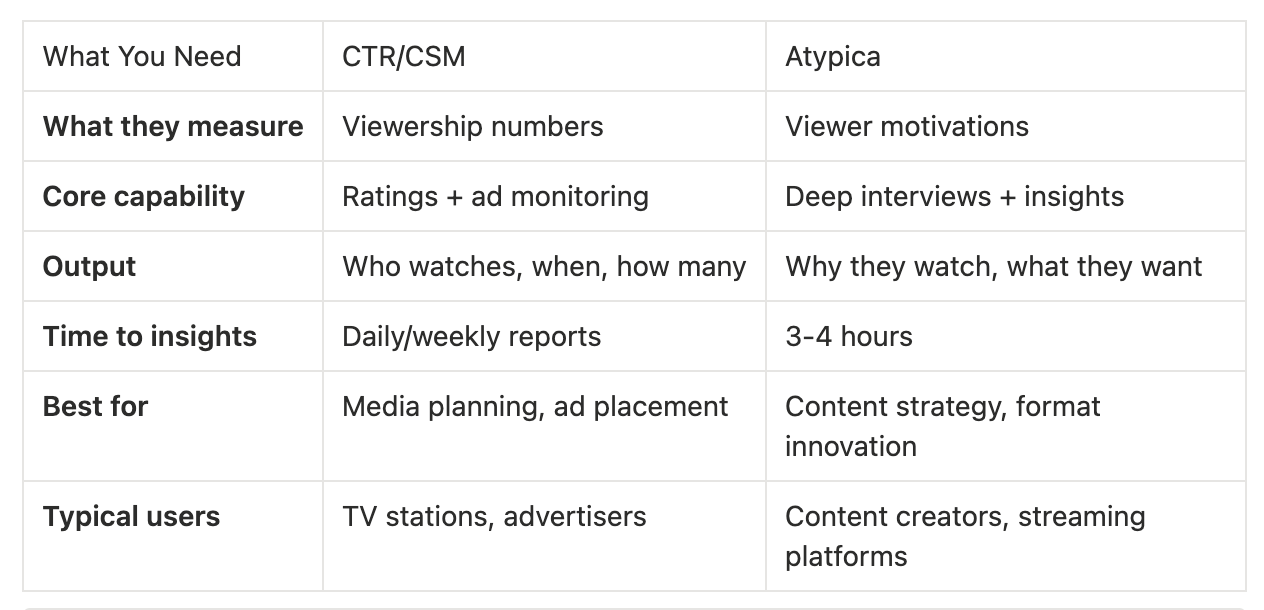
The reality: CTR tells you ratings dropped 20%. Atypica tells you it’s because 15-minute ads drove viewers to short-form platforms—and how to win them back.
Why Atypica Complements (and Often Replaces) CTR
1. Strategic Insights, Not Just Performance Data
CTR’s strength: Precise measurement of who’s watching what, when.
CTR’s limitation: A show rating 2.5 could mean engaged fans or passive background viewing. You don’t know why people watch or what would make them watch more.
Atypica’s capability: Deep interviews reveal viewing motivations.
Real example: CTR data shows a reality show’s ratings declining among women 35-50.
Atypica interviews reveal why:
Viewer A: “I don’t dislike it—I’m just ‘accompanying’ my parents. They chose it. If you made content we both enjoy, I’d actually watch.”
Viewer B: “15 minutes of ads in a 60-minute show? I switched to Douyin highlights instead. Three minutes, no waiting.”
Strategic recommendations:
Create intergenerational content (expand appeal)
Cut ad load to compete with short-form
Launch highlight versions for time-pressed viewers
The difference: CTR shows the symptom (declining ratings). Atypica diagnoses the cause and prescribes the cure.
2. Content Validation Before Production
CTR’s constraint: Can only measure existing content after broadcast.
What this means: You invest months developing a show, then wait for CTR data to learn it’s not working. By then, you’ve spent the budget.
Atypica’s advantage: Validate concepts before production.
A streaming platform testing three new show formats can use atypica to:
Interview target viewers about each concept
Identify which format resonates (9/10 interest vs 5/10)
Understand why certain formats fail
Refine the winner before filming begins
Value: Avoid producing content that CTR data would later reveal as unsuccessful.
3. Multi-Method Discovery vs Single Metric
CTR’s method: Panel-based measurement—accurate but narrow.
Atypica’s methods:
Interviews: Deep conversations about viewing habits
Discussion: Group dynamics revealing unspoken preferences
Scout: Social media observation (Weibo, Xiaohongshu, Bilibili) showing real reactions
webSearch: Competitive and trend analysis
Why this matters: A viewer who rates 7/10 in CTR data might post on Xiaohongshu: “Watching because there’s nothing else, but the host is annoying.” Social observation captures what surveys miss.
What CTR Can’t Do (And When You Need Atypica)
1. Understanding the “Why” Behind Behavior
CTR tells you a show’s audience is 60% female, 35-50 years old, watching at 8PM.
What it doesn’t tell you:
Why they choose this show over competitors
What would make them recommend it
Why similar shows with worse ratings have more social buzz
What content gaps exist in the market
Atypica’s deep interviews answer these questions. For content strategy, knowing why matters more than knowing how many.
2. Adapting to New Media Realities
CTR’s focus: Traditional TV measurement.
Today’s reality: Viewers watch across platforms—TV, streaming apps, short-form video, social clips.
A show might have modest CTR ratings but huge engagement on Bilibili and Douyin. CTR measures the TV audience. Atypica’s social observation captures the full picture—including viewers who consume content in 3-minute clips rather than full episodes.
Strategic insight: Maybe the problem isn’t the content. Maybe it’s the format. Viewers want your content—just not in 60-minute episodes.
3. Competitive Intelligence Beyond Ratings
CTR compares your ratings to competitors. But it doesn’t explain why Competitor A, with lower ratings, dominates social conversation and sponsor interest.
Atypica research reveals: Their controversial host drives discussion. Lower ratings, but higher engagement and brand value.
This insight changes strategy: Ratings aren’t everything. Engagement might be more valuable.
When CTR Remains Essential
CTR delivers unique value for:
Media planning and ad buying (need audience guarantees)
Industry benchmarking (standardized measurement)
Ad effectiveness tracking (reach and frequency)
Regulatory compliance (official audience data)
Scenario: An advertiser spending ¥50M on TV campaigns needs CTR’s authoritative ratings to allocate budget and measure ROI.
The distinction: CTR serves the media buying ecosystem. Atypica serves content creators and strategists.
Real Case: The 30% Ratings Drop
Background: A variety show’s ratings fell from 3.0 to 2.1 over three months.
CTR data revealed:
Women 35-55 churning fastest
Weekday viewership stable, weekend dropping
Competitor show gaining in same time slot
What CTR didn’t explain: Why the churn? What changed?
Atypica research revealed (3 hours, 15 deep interviews):
Viewer A: “The show’s fine, but 2 hours per episode? I barely have time for dinner. Douyin shows me the best moments in 5 minutes. Why would I commit 2 hours?”
Viewer B: “Every episode has the same structure now. Guest arrives → game → emotional moment → end. It’s predictable. Competitor’s show surprises me every time.”
Viewer C: “My kids are grown. I’m not watching ‘family content’ anymore—I want something sophisticated. This show still treats me like a mom, not a person.”
Strategic recommendations:
Launch 45-minute “express” version (compete with short-form)
Break the formula—unexpected segments each episode
Mature content tone (respect audience evolution)
Implementation results: Three months later, ratings recovered to 2.8. More importantly, social engagement increased 60%, attracting premium sponsors who value audience quality over quantity.
The lesson: CTR identified the problem. Atypica solved it.
Common Questions
Q: Can atypica replace CTR for our needs?
Not if you’re buying ads or need regulatory compliance. CTR’s authoritative measurement serves essential industry functions.
But if your goal is understanding audiences to create better content, atypica provides insights CTR cannot. Most content teams need both: CTR for measurement, atypica for strategy.
Q: Why not just read social media ourselves instead of using atypica?
You could. But atypica’s Scout method systematically analyzes conversations at scale, identifies patterns, and connects social sentiment to strategic recommendations.
Reading Weibo gives you anecdotes. Atypica gives you validated insights from structured research combining social observation with direct interviews.
Q: CTR uses real panel data. Isn’t that more accurate than AI interviews?
For measuring what happened, yes—CTR’s panel data is authoritative.
For understanding why it happened, AI interviews excel. They can probe deeper, ask follow-ups, and explore hypotheticals (”What would make you watch more?”) that panel measurement can’t capture.
They’re measuring different things. CTR measures behavior. Atypica explains it.
The Core Takeaway
CTR built infrastructure for media planning. Atypica built tools for content strategy.
Not “which is better”—both excel at their purpose. The question is: “What do you need to know?”
If you need to prove audience size for advertisers or benchmark against competitors, CTR’s measurement is essential.
If you need to understand why audiences behave as they do and how to create content they’ll love, atypica delivers insights CTR cannot provide.
For most content teams, the answer is using atypica more often—because strategy beats measurement. You can’t optimize what you don’t understand.
Ready to understand your audience? Run atypica.AI research toda!
Let’s start now! 👉https://atypica.ai


