

When consultants and product teams discover NotebookLM’s ability to transform dense documents into engaging AI-hosted podcasts, the reaction is often immediate enthusiasm. Upload a 50-page industry report, and within minutes, two AI hosts are discussing its key insights in natural conversation. For anyone drowning in research papers, competitor analyses, or strategic documents, this feels transformative.
But here’s where confusion often arises: both NotebookLM and Atypica can generate podcast-style content. Both use AI to help with research-related work. Both promise to make research faster.
The critical difference lies not in the format, but in the fundamental question each tool answers: NotebookLM asks “What does this document say?” Atypica asks “What would target users actually think?”
NotebookLM synthesizes knowledge you already have. Atypica generates insights you don’t have yet. They’re not alternatives—they’re complementary tools for different stages of research work. Understanding when to use each can mean the difference between presenting synthesized literature and presenting original strategic insights.
Core Methodology Comparison
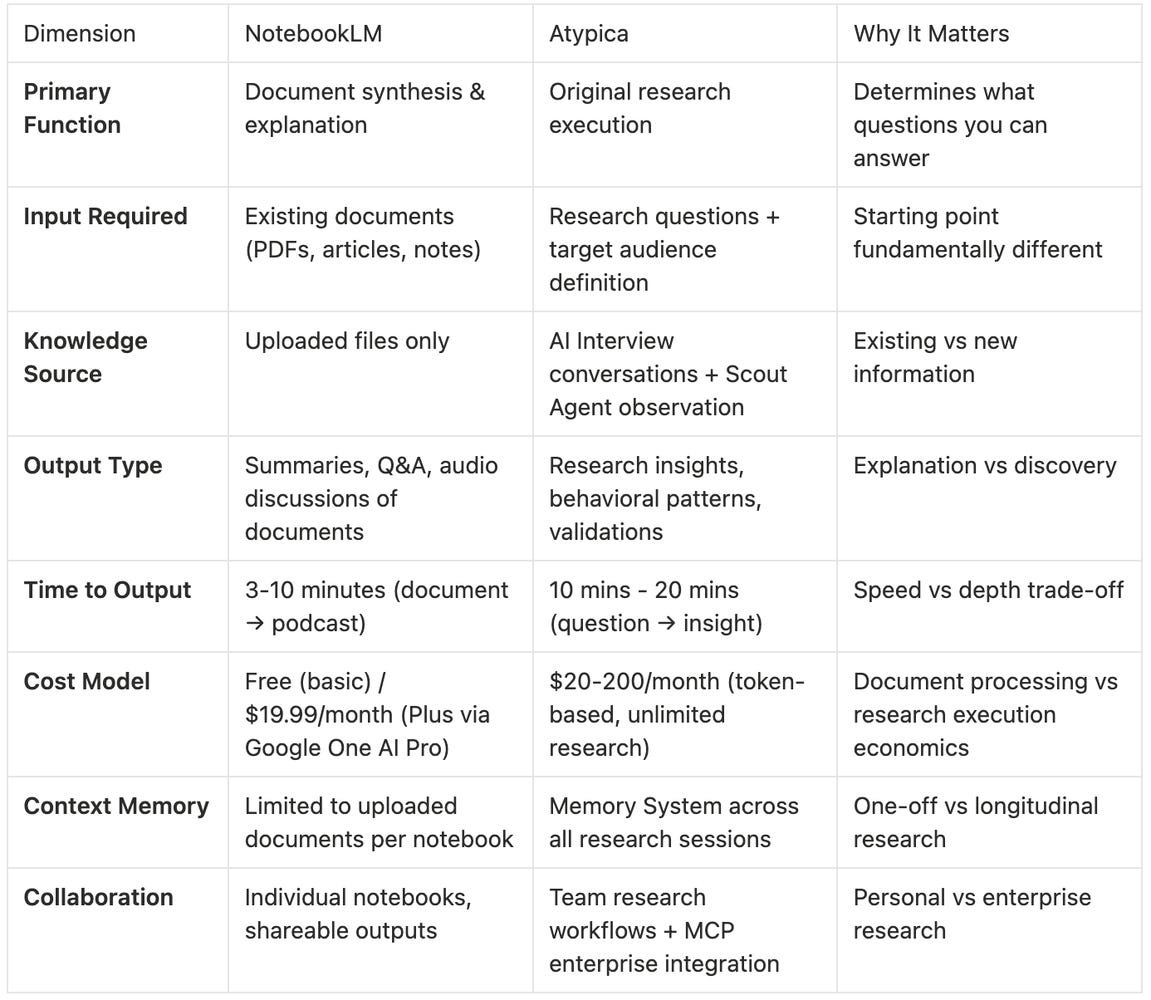
The fundamental distinction: NotebookLM is a knowledge synthesis tool. Atypica is a research execution platform.
NotebookLM: Making Existing Knowledge Accessible
Core Strengths
What NotebookLM does exceptionally well:
Document Synthesis - Upload 50 pages of dense technical documentation and get a coherent, conversational podcast discussing the key points within 5 minutes.
Multi-Source Integration - Combine multiple PDFs, articles, Google Docs, YouTube transcripts, and website content into unified understanding.
Accessibility Transformation - Convert expert-level content into formats accessible to broader audiences (summaries, study guides, audio).
Learning Acceleration - Dramatically faster comprehension of documented knowledge compared to traditional reading.
Current Capabilities (2026)
Pricing & Plans:
Free Tier:
100 notebooks maximum
50 sources per notebook
All core features (summaries, Q&A, podcast generation)
No usage limits on free features
NotebookLM Plus ($19.99/month via Google One AI Pro):
500 notebooks maximum
300 sources per notebook (6x capacity increase)
5x higher usage limits
Includes 2TB Google storage
Includes Gemini Advanced access
Student discount: $9.99/month (50% off, first year)
Enterprise (Google Workspace Standard: $14/user/month):
NotebookLM Plus features included
Team collaboration capabilities
Administrative controls
Google AI Ultra (Premium tier):
Highest Gemini model access
Remove watermarks from generated presentations
Priority feature access
Create slide decks and infographics
Core Features:
Input Formats: PDF, Google Docs, website links, YouTube videos (transcript), copied text
Output Options: Text summaries, FAQ lists, timeline views, podcast-style audio
Podcast Generation: 3-5 minutes for engaging 2-host AI discussion
Study Tools: Generated study guides, key concept extraction
Real-time Q&A: Ask questions about uploaded content
Limitations Consultants Encounter
Document Dependency:
Cannot generate insights beyond what’s in uploaded documents
If answer isn’t in your files, NotebookLM cannot help
Limited by quality and recency of source materials
No Original Research:
Cannot interview users or personas
Cannot test concepts with target audiences
Cannot explore “what if” scenarios not documented
Cannot observe behavioral context
Context Boundaries:
Each notebook is standalone (limited cross-notebook learning)
Cannot maintain context across different document sets
Fresh start with each new upload
Strategic Gap:
Excellent at “What does existing research say?”
Cannot answer “How would our target customers react?”
Synthesizes past knowledge, doesn’t generate future insights
Real consultant scenario: A strategy consultant uploaded 200 pages of healthcare industry reports to NotebookLM. The podcast beautifully explained market trends. But when the client asked “How would CIOs at 500-bed hospitals react to our pricing model?” NotebookLM had no answer—that insight wasn’t in the documents.
Atypica: Executing Research to Generate New Insights
Core Strengths
What Atypica does differently:
Original Research Execution - Don’t have answers yet? AI Interview conducts systematic conversations with behavioral personas to generate insights.
Concept Validation - Test product ideas, messaging, or positioning with AI personas before building, without waiting weeks for human recruitment.
Behavioral Context - Scout Agent observes social media to understand target audiences’ lifestyles, values, and decision contexts surveys can’t capture.
Longitudinal Research - Memory System retains context across sessions, enabling progressive learning over weeks or months.
Current Capabilities (2026)
Pricing Structure:
Pro: $20/month, 2M tokens/month
Max: $50/month, 5M tokens/month
Super: $200/month, unlimited tokens
Core Research Features:
AI Interview Mode: Multi-turn conversational research with adaptive follow-ups
Three-Tier Persona System: Behavioral consistency based on psychographic + demographic patterns
Scout Agent: Social media observation (Reddit, LinkedIn, forums) for lifestyle context
Memory System: Persistent context across all research sessions
Plan Mode: Auto-structures research approach before execution
Insight Radio: Converts research findings to podcast format
Reference Studies: Analyzes documents within research context
MCP Integration: Connects to CRM, analytics, support tickets for enterprise data context
AI Sage: Evolving pattern recognition across research projects
Quantified Advantages
Research Speed:
Traditional human interviews: 2-3 weeks recruitment + 1-2 weeks scheduling
Atypica: Same-day research execution
90% faster time-to-insight compared to traditional qualitative research
Research Economics:
Human interview panels: $75-150 per 45-minute session
30 interviews = $2,250-4,500
Atypica: $20-200/month unlimited interviews
83-93% cost reduction for qualitative research depth
Iteration Capacity:
Traditional: Each iteration requires new recruitment cycle (7-14 days)
Atypica: Immediate iteration with Memory System context
Enable weekly research sprints vs monthly projects
Limitations to Acknowledge
What Atypica isn’t designed for:
Document Synthesis - If you have 50 PDFs to understand quickly, NotebookLM is purpose-built for this. Atypica focuses on research execution, not document explanation.
Literature Review - Synthesizing published research across multiple sources? NotebookLM’s strength. Atypica generates original insights through conversations.
Learning Aid - Studying for exams or onboarding to documented knowledge? NotebookLM creates better study materials.
Free Exploration - NotebookLM offers free document analysis. Atypica requires paid subscription for research execution.
Public Information Summary - If answers exist in published documents, NotebookLM finds and explains them faster than conducting original research.
Multi-Dimensional Comparison Framework
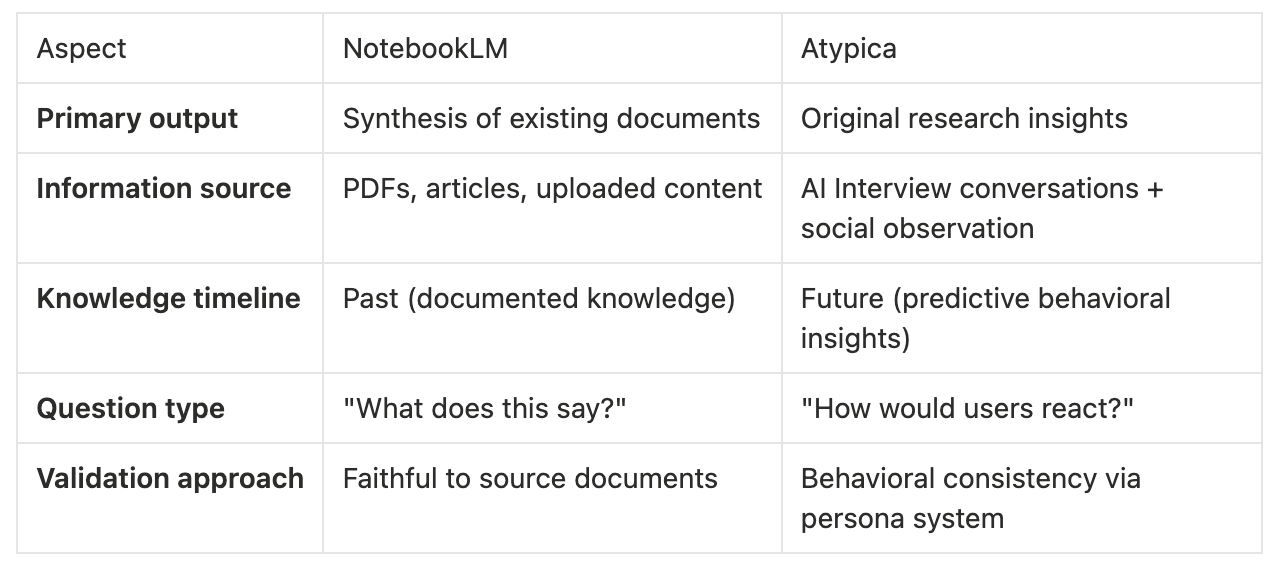
1. Knowledge Generation Type
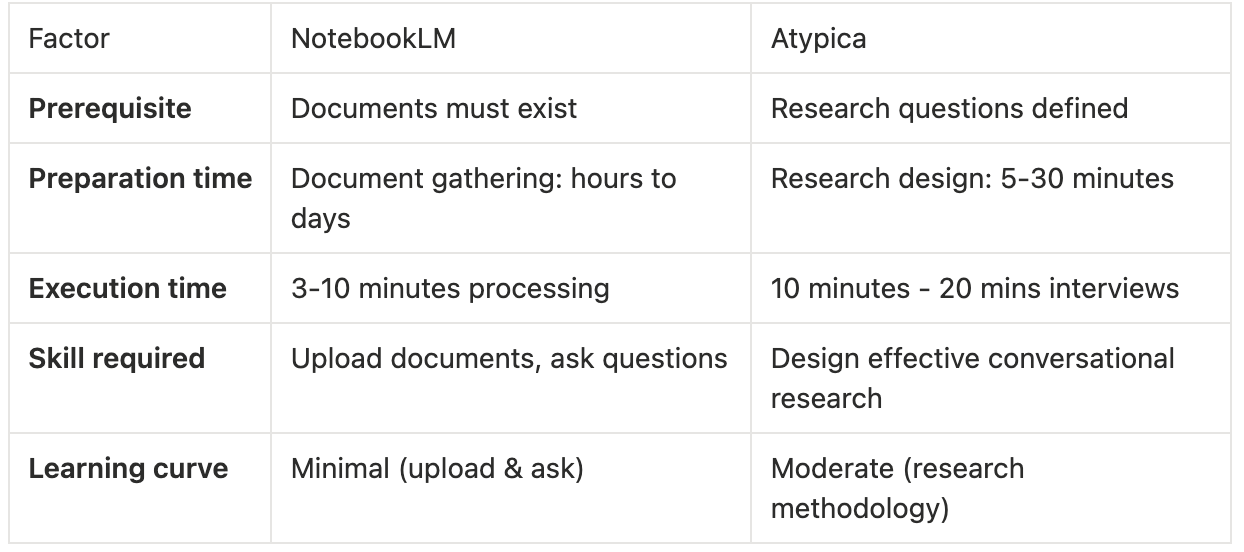
2. Workflow Requirements
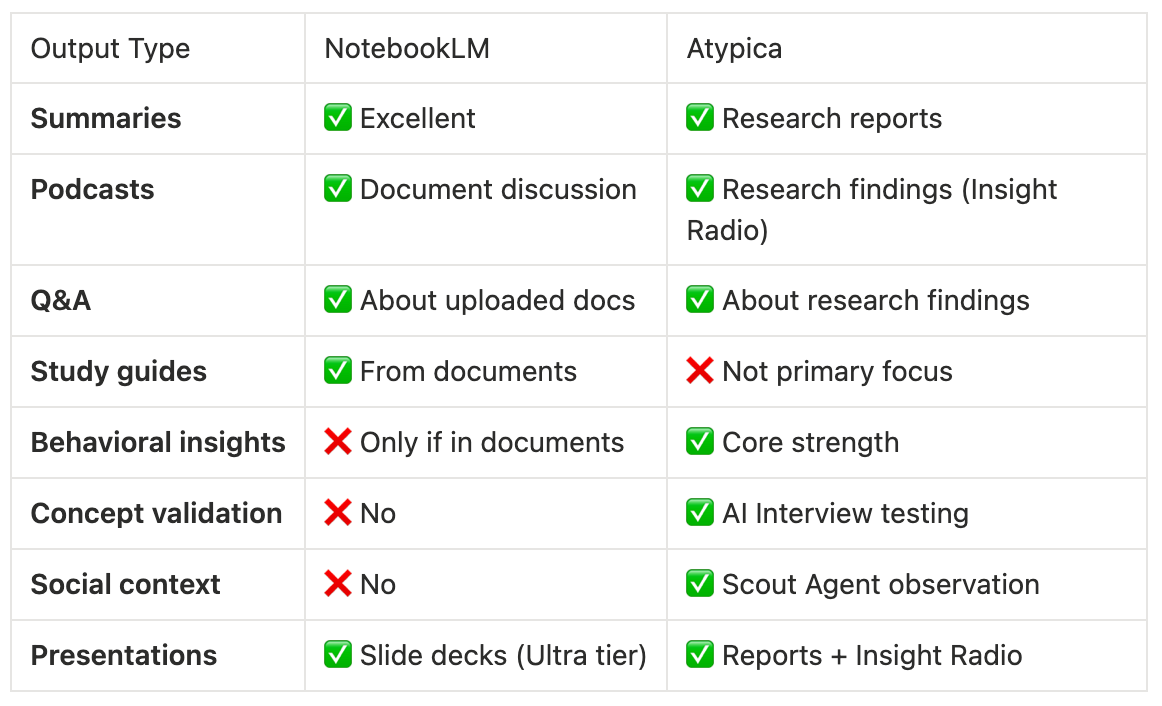
3. Output Capabilities
4. Context & Memory
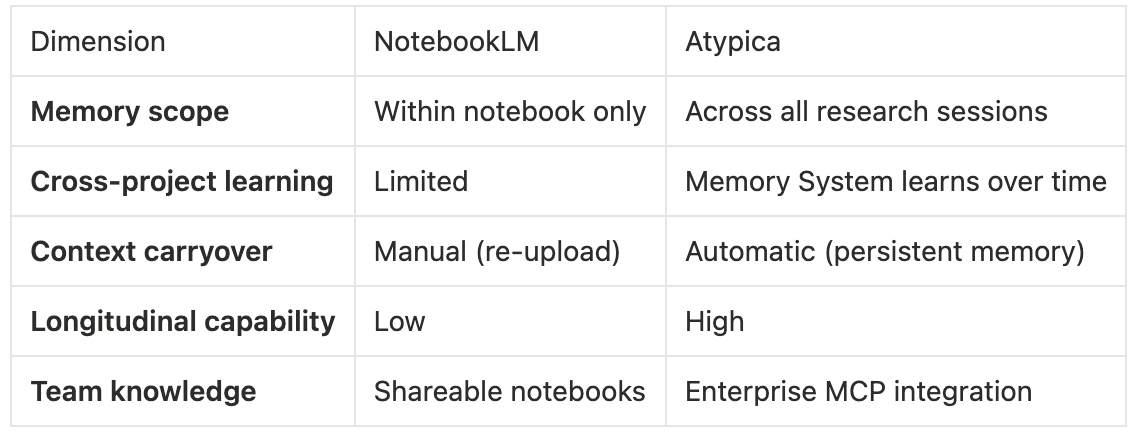
5. Cost Economics
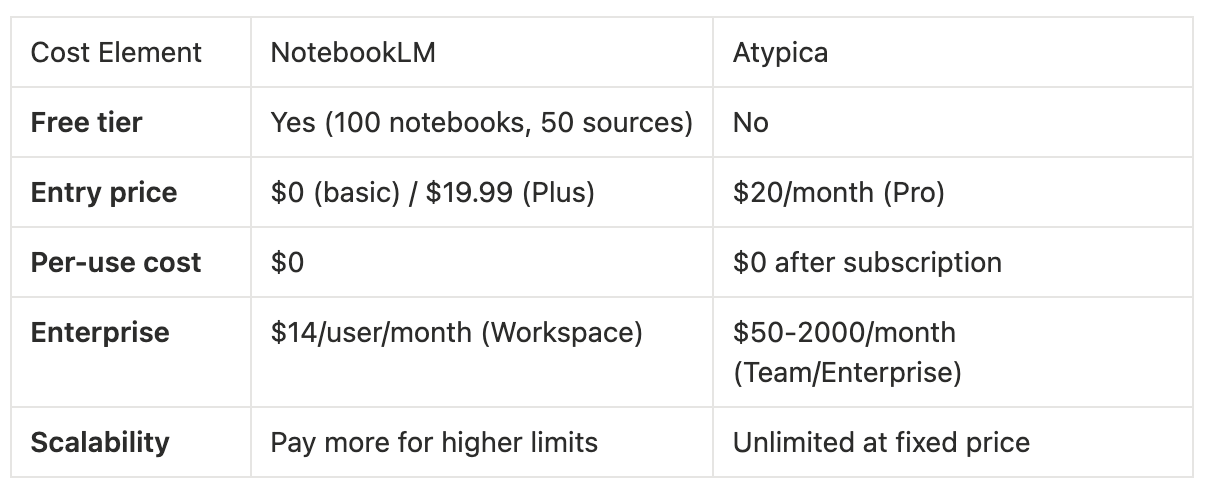
Break-even analysis: If you conduct >2 research projects per month with human participants, Atypica’s unlimited model becomes more economical than per-participant recruitment costs.
6. Use Case Fit
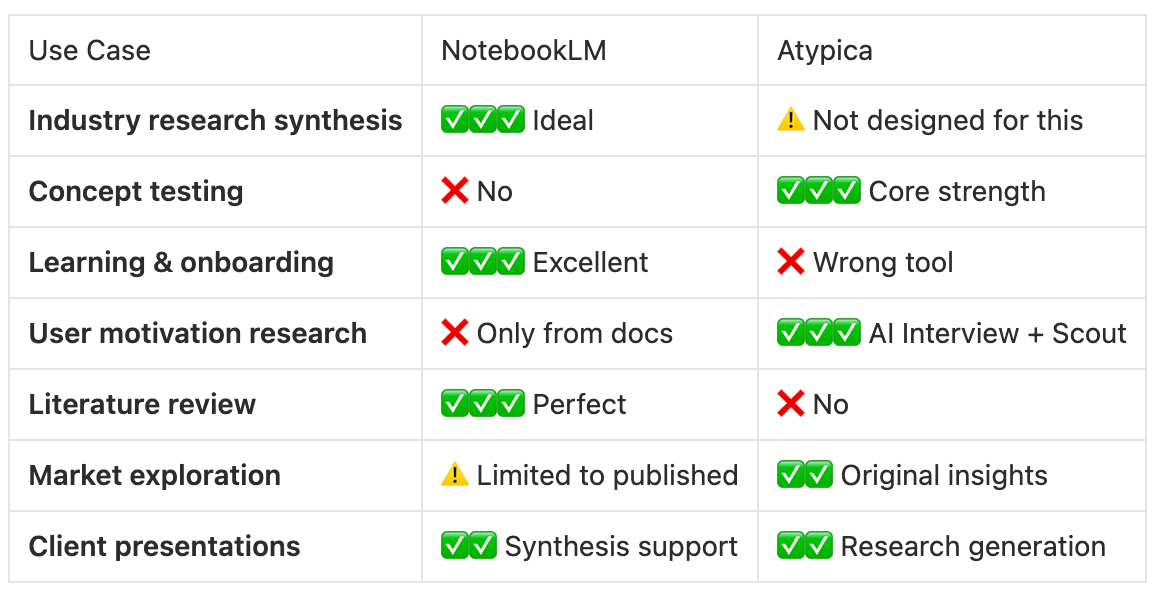
Scenario-Based Decision Framework
Choose NotebookLM when:
✅ You have documents to understand quickly
50+ pages of industry reports to digest
Competitor documentation to synthesize
Internal research archives to make accessible
Academic papers to comprehend
✅ Team learning and onboarding
New consultants need to understand documented projects
Product teams need to grasp market research reports
Sales teams need digestible competitive intelligence
✅ Creating accessible content from existing materials
Transform technical documentation into podcasts
Generate study guides from research literature
Make expert content accessible to broader audiences
✅ Budget constraints
Free tier sufficient for most document synthesis
$19.99/month for higher limits (500 notebooks, 300 sources)
No research execution budget
✅ Time-sensitive document comprehension
Need to understand materials in minutes, not hours
Preparing for client meeting with briefing materials
Quickly synthesizing competitor reports
Choose Atypica when:
✅ Conducting original research
No documents exist with the answers you need
Testing concepts before building
Understanding behavioral motivations
Exploring market opportunities not yet documented
✅ Validating strategic assumptions
“How would enterprise CIOs react to this pricing?”
“What concerns would prevent adoption?”
“Which of three positioning strategies resonates most?”
Questions documents can’t answer
✅ Understanding behavioral context
Scout Agent reveals what target users discuss on social media
Lifestyle and values context beyond demographics
Decision-making patterns surveys miss
✅ Rapid iteration requirements
Weekly research sprints aligned with development
Test messaging variations within hours
Memory System enables progressive learning
✅ Deep qualitative research at scale
Traditional 30-interview qualitative study: $2,250-4,500 + 3-4 weeks
Atypica: $129-899/month, unlimited interviews, same-day insights
Economic viability of depth
✅ Enterprise research operations
MCP integration connects to CRM, analytics, support data
Memory System maintains organizational research knowledge
Continuous research culture, not periodic projects
Use both strategically when:
✅ Comprehensive market entry strategy
NotebookLM: Synthesize all published market research (Day 1-2)
Atypica: Conduct original research on positioning and messaging (Day 3-5)
NotebookLM: Create final presentation combining both (Day 6)
✅ Client engagement workflow
NotebookLM: Digest client briefing materials quickly
Atypica: Execute research on strategic questions
NotebookLM: Synthesize research findings with background into presentation
Deliver insights based on both published knowledge and original research
✅ Product development cycle
NotebookLM: Understand competitor feature documentation
Atypica: Test your feature concepts with AI Interview
NotebookLM: Create team-aligned documentation of approach
Combine documented best practices with validated concepts
Real-World Application: Case Study
Scenario: Healthcare SaaS Market Entry Strategy
Client: B2B SaaS company planning healthcare vertical expansion
Challenge: Should we build healthcare-specific features or enter with core platform?
Timeline: 2 weeks for recommendation
Budget: $8,000 research allocation
Phase 1: Literature Synthesis with NotebookLM (Days 1-2)
Approach:
Gathered 150 pages: industry reports, regulatory guides, competitor analyses
Uploaded to NotebookLM (free tier, 50 sources)
Generated podcasts on: healthcare IT landscape, compliance requirements, buyer personas
Created FAQ on healthcare-specific terminology
Time: 6 hours total
Insights Gained:
✅ Understanding of HIPAA/HITECH compliance frameworks
✅ Healthcare IT buying cycles (12-18 months typical)
✅ Key vendor landscape and competitive positioning
✅ Published statistics on healthcare IT spending
What NotebookLM Couldn’t Answer:
❌ “Would healthcare CIOs pay 40% premium for healthcare-specific features?”
❌ “What concerns would prevent trial-to-purchase conversion?”
❌ “How do decision-makers at 200-bed vs 500+ bed hospitals differ?”
❌ “Which of our value propositions resonates most?”
Cost: $0 (free tier sufficient)
Phase 2: Original Research with Atypica (Days 3-8)
Research Design:
Defined 3 persona types: CIO (500+ beds), IT Director (200-500 beds), IT Manager (<200 beds)
30 AI Interview conversations (10 per persona type)
Scout Agent observed r/healthcare_IT, LinkedIn health IT groups
Tested 2 positioning approaches + 3 feature concepts
Key Findings:
Pricing sensitivity by hospital size:
Decision barriers discovered:
Positioning validation:
Feature prioritization:
Time: 5 days (research design + execution + analysis)
Cost: $329 (Atypica Max plan, month 1)
Phase 3: Synthesis with NotebookLM (Days 9-10)
Approach:
Documented Atypica research findings (18-page report)
Uploaded to NotebookLM with Phase 1 industry materials
Generated final podcast combining: industry context + original research insights
Created client presentation outline
Final Deliverable:
Comprehensive podcast (22 minutes): market context → research findings → strategic recommendation
Slide deck: 35 slides with both quantitative market data and qualitative research insights
Recommendation: Enter with core platform + EHR integration roadmap, defer healthcare-specific features until reference customers acquired
Time: 2 days
Cost: $0 (existing NotebookLM free tier)
Total Project:
Timeline: 10 days (vs 4-6 weeks traditional approach)
Cost: $329 (vs $6,000-10,000 for traditional research agency)
Outcome: Client approved market entry strategy, successfully entered healthcare vertical within 6 months
Why the combination worked:
NotebookLM accelerated understanding of documented market context
Atypica answered strategic questions documents couldn’t address
NotebookLM synthesized both into compelling client presentation
Each tool handled what it was designed for
Industry Trends: The Evolution of Research Work
From Sequential to Parallel Knowledge Work
Traditional Research Model:
Literature review: Week 1-2 (read everything manually)
Original research: Week 3-6 (recruit, interview, analyze)
Synthesis: Week 7-8 (combine findings into deliverable)
Total: 7-8 weeks
Emerging Hybrid Model:
Literature synthesis: Day 1-2 (NotebookLM podcasts while working)
Original research: Day 3-5 (Atypica AI Interview execution)
Synthesis: Day 6 (NotebookLM combines both)
Total: 6 days
What’s changing: AI tools compress timelines not by sacrificing quality, but by eliminating waiting periods (recruitment delays, manual reading time).
Democratization of Research Capabilities
Traditional Barriers:
Only research specialists could conduct qualitative interviews
Only speed readers could synthesize extensive literature quickly
Consultants dependent on external research agencies
New Reality:
Strategy consultants execute their own qualitative research (Atypica)
Product managers synthesize industry reports in minutes (NotebookLM)
Research becomes continuous capability, not periodic purchase
Impact for consultants: Client projects no longer bottlenecked by “waiting for research.” Background synthesis (NotebookLM) and original research (Atypica) happen concurrently, not sequentially.
The Hybrid Research Professional
Evolving skill set:
Document synthesis fluency: Using NotebookLM to quickly extract documented knowledge
Research design expertise: Framing questions Atypica’s AI Interview can explore
Strategic integration: Knowing when insights need documents vs conversations
Insight synthesis: Combining multiple knowledge sources into recommendations
What this means: The competitive advantage shifts from “access to research tools” to “strategic research design and synthesis.”
Honest Strengths & Limitations Analysis
NotebookLM
Undeniable Strengths:
✅ Free tier generous (100 notebooks, 50 sources each)
✅ Fastest document-to-understanding tool available (3-10 minutes)
✅ Exceptional podcast quality (natural, engaging AI hosts)
✅ Multi-source synthesis (combine PDFs, videos, articles)
✅ Zero learning curve (upload & ask)
✅ Google integration (Docs, Workspace, Cloud)
✅ Study tools generation (guides, FAQs, timelines)
Honest Limitations:
❌ Cannot generate insights beyond uploaded documents
❌ No cross-notebook learning or memory
❌ Cannot conduct original research or interviews
❌ Cannot test concepts with target audiences
❌ Limited to documented, past knowledge
❌ Notebook isolation (no enterprise knowledge graph)
❌ Source quality directly limits output quality
Atypica
Undeniable Strengths:
✅ Generates original research insights documents can’t provide
✅ AI Interview enables concept validation before building
✅ Scout Agent reveals behavioral context from social media
✅ Memory System learns across all research sessions
✅ Unlimited research at fixed subscription cost
✅ 90% faster than traditional qualitative research
✅ 83-93% cost reduction vs human interview panels
✅ MCP integration for enterprise data context
Honest Limitations:
❌ Not designed for document synthesis (NotebookLM’s strength)
❌ Requires research methodology expertise to design effective studies
❌ Cannot replace human research for final validation or regulatory compliance
❌ Some stakeholders skeptical of AI-simulated research
❌ Not suitable for literature review or learning from existing materials
FAQ
Q: Both generate podcasts—aren’t they the same?
A: The podcast format is similar (conversational audio), but content sources are completely different:
NotebookLM podcast: Two AI hosts discuss ideas from YOUR uploaded documents
Atypica Insight Radio: Presents findings from research Atypica conducted via AI Interview
Example: If you upload 50 pages to NotebookLM, the podcast explains those 50 pages. If you ask Atypica “How would CIOs react to our pricing?” the podcast presents research findings from AI Interview conversations—insights that didn’t exist before.
Q: Can I use both tools together?
A: Yes—this creates powerful research workflows:
Sequential workflow:
NotebookLM: Synthesize existing market research (hours)
Atypica: Conduct original research on strategic questions (days)
NotebookLM: Combine both into final deliverable (hours)
Parallel workflow:
Use NotebookLM for background learning while Atypica research runs
Upload Atypica findings to NotebookLM for team education podcasts
Maintain separate context: documents (NotebookLM) + conversations (Atypica)
Result: Depth of original research + breadth of documented knowledge.
Conclusion: Complementary Tools for Comprehensive Research
The surface similarity between NotebookLM and Atypica—both use AI, both can generate podcasts—masks their fundamental difference in purpose and capability.
NotebookLM is a knowledge synthesis engine. It transforms documents you already have into formats you need: summaries for quick understanding, podcasts for accessible learning, study guides for team onboarding. For anyone needing to quickly comprehend documented knowledge, it’s invaluable—and the free tier makes it accessible to everyone.
Atypica is a research execution platform. It conducts systematic inquiry to answer questions documents can’t address: How would target users react? Which concept resonates most? What behavioral factors drive decisions? Through AI Interview, Scout Agent, and Memory System, it generates original insights that create strategic value.
The strategic opportunity lies in combination:
For consultants and product teams, the most effective approach uses both sequentially:
NotebookLM first: Synthesize existing knowledge in hours (industry reports, competitor analyses, internal documentation)
Atypica second: Generate original insights answering strategic questions (concept validation, user motivations, positioning tests)
NotebookLM again: Combine documented knowledge + original research into client-ready deliverables
Together, they enable research that’s both comprehensive and fast: understand all existing knowledge quickly (NotebookLM), then generate the strategic insights that differentiate your work (Atypica).
The future of research isn’t choosing between synthesis and execution—it’s integrating both into continuous, agile research workflows that compress 8-week projects into 6-day sprints.
Ready to add research execution capability beyond document synthesis? Explore Atypica’s AI Interview and Scout Agent at https://atypica.ai


