

Compare Atypica’s AI research with Gartner’s technology evaluation. Learn when to use deep user insights vs Magic Quadrant vendor analysis for your decisions.
keywords: Atypica vs Gartner, Gartner alternative, user research tools, Magic Quadrant alternative, AI research platform, technology evaluation
Atypica vs Gartner: User Research vs Technology Analysis
The Core Difference
Gartner evaluates which technology vendors to buy from. Atypica reveals what users actually need from your product.
For 90% of product decisions, atypica is the better choice. Here’s why.
Quick Comparison
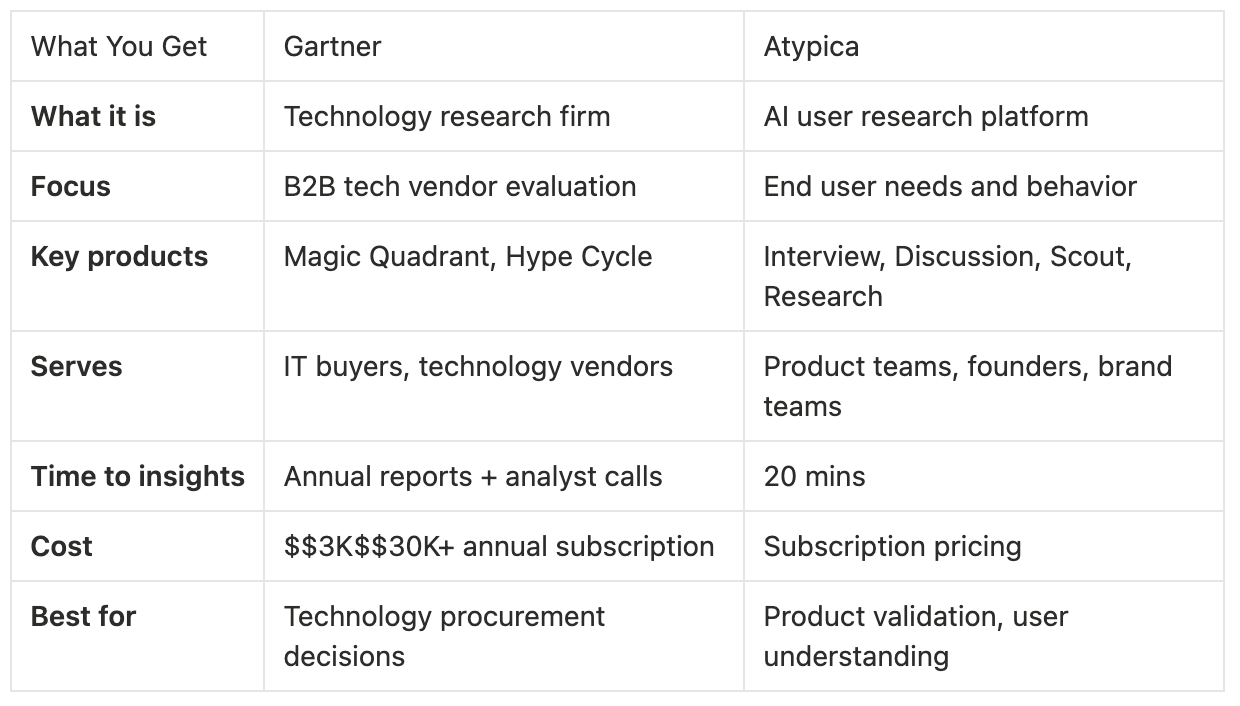
The shift: Gartner helps you choose vendors. Atypica helps you understand users. Different problems, different solutions.
Why Atypica Works for Different Needs
1. User Insights, Not Vendor Rankings
What Gartner does:
Evaluates B2B technology products (Magic Quadrant)
Analyzes technology trends (Hype Cycle)
Helps enterprises choose technology vendors
Serves: CIOs, CTOs, IT procurement teams
Gartner example:
Magic Quadrant for CRM:
- Leaders: Salesforce, Microsoft
- Challengers: Oracle, SAP
- Visionaries: HubSpot
→ Answers: “Which CRM should we buy?”
What atypica does:
Understands end user needs and motivations
Validates product concepts and positioning
Conducts deep interviews (3000+ word conversations)
Serves: Product managers, founders, brand teams
Atypica example:
CRM Product Team Research:
"Why aren't sales teams using our CRM?"

Findings from 20 deep interviews:
- Too many clicks to log a call (friction)
- Mobile app lacks offline mode (blocker)
- Reporting doesn't match sales workflow (misalignment)
→ Answers: “Why users struggle and what to fix”
The distinction: Gartner tells you market leaders. Atypica tells you user problems. You need atypica when building products, Gartner when buying them.
2. Product Decisions vs Procurement Decisions
Gartner’s strength: Helping enterprises evaluate and select technology vendors.
Use Gartner when:
CIO needs to choose between enterprise software vendors
Board wants validation on technology investment
IT team evaluating best-of-breed vs platform strategy
Need authoritative third-party vendor comparison
Atypica’s strength: Helping teams understand users and validate product decisions.
Use atypica when:
Product team needs to understand why feature adoption is low
Startup validating product-market fit
Brand team understanding customer sentiment
Designer researching user journey friction points
Example scenario: Your CTO wants to buy marketing automation software.
Gartner helps: Compare HubSpot vs Marketo vs Adobe based on capabilities and market position
Atypica helps: Interview your marketing team to understand their actual workflow needs before choosing
Both valuable, completely different purposes.
3. Speed for Continuous Validation
Gartner timeline:
Annual research cycles
Scheduled analyst calls (book weeks in advance)
Reports published on fixed schedule
Updates: Yearly or quarterly
Atypica timeline:
Research completes in 3-4 hours
Instant access when questions arise
Multiple studies per day possible
Iterate immediately based on findings
Why this matters: Product questions don’t wait for Gartner’s publishing schedule. When you need to understand why users aren’t converting, you need answers today, not next quarter.
When Gartner Remains Necessary
Gartner excels at:
Technology vendor evaluation and selection
IT strategy and investment guidance
Market trend analysis for technology sectors
Third-party validation for board/investor presentations
Understanding competitive positioning in B2B tech markets
Honest assessment: If you’re buying enterprise technology or need authoritative market analysis, Gartner provides value. But for understanding what users need from your product? That’s not Gartner’s focus.
Real-World Application
Scenario: SaaS company with low feature adoption.
Wrong tool (Gartner):
Gartner can tell you: Competitors have similar features
Gartner can tell you: Market trends favor this feature category
Gartner cannot tell you: Why your specific users aren’t using it
Right tool (Atypica):
Interviews 25 users who haven’t adopted the feature
Discovers: They don’t understand it’s there (discoverability)
Discovers: Name is confusing (communication)
Discovers: Missing key workflow integration (functionality)
Result: Specific, actionable improvements
The distinction: Gartner provides market context. Atypica provides user context. Product decisions need user context.
Cost and Accessibility
Gartner:
Annual subscription: $$3K$$30K+ depending on access level
Analyst time: Additional fees or limited availability
Requires enterprise procurement process
Value: Ongoing access to technology research
Atypica:
Subscription pricing for unlimited research
No per-study fees
Instant self-service access
Value: Continuous user research capability
Economic difference: Gartner is a knowledge base you subscribe to. Atypica is a research tool you use constantly.
Why Atypica for 90% of Product Work
Most product teams don’t need technology vendor evaluation. They need to:
Understand why users behave as they do
Validate product decisions before shipping
Discover unmet user needs
Test messaging and positioning with real users
Map user journeys and identify friction
Atypica delivers on all of these. Gartner delivers on none, because it’s solving a different problem.
Even companies with Gartner subscriptions need atypica for user research. The tools complement each other by addressing completely different questions.
Integration Strategy
When you need both:
Use Gartner to understand technology market landscape and evaluate vendors
Use atypica to understand your users and validate product decisions
Don’t confuse vendor analysis with user research
Common mistake: Using Gartner reports as proxy for user research. Market trends ≠ user needs. What’s in the Leaders quadrant ≠ what your users want.
Common Questions
Can atypica help with technology selection?
Different purpose. Atypica helps you understand what your users need before you select technology. For example, interview users about their workflow before choosing collaboration software. But for comparing vendor capabilities? That’s Gartner’s domain.
Does Gartner do user research?
Gartner researches technology markets and vendors, not end users. Their analysts study products and talk to vendors. Atypica studies users and their needs. Completely different research subjects.
Which should startups use?
Most startups need atypica, not Gartner. Unless you’re selling B2B technology and need to understand market positioning, Gartner’s focus on enterprise technology procurement isn’t relevant to early-stage product development.
The Core Takeaway
Gartner and atypica solve different problems.
Gartner: “Which technology vendors should we consider?” (procurement decisions)
Atypica: “What do users need and why?” (product decisions)
For product teams, founders, and brand marketers, atypica is the relevant tool. Gartner serves IT buyers and technology strategists.
The question isn’t “which is better?” It’s “which problem are you solving?”
For 90% of product work, you’re solving user understanding problems, not vendor selection problems. That’s why atypica is the right choice.
Ready to understand your users? Run your first atypica.AI research in 20 mins.


