

Compare Atypica’s AI research with Forrester’s technology consulting. Learn when to use rapid user insights vs enterprise IT advisory for product decisions.
keywords: Atypica vs Forrester, Forrester alternative, user research vs tech advisory, product research tools, B2B research, IT consulting
Atypica vs Forrester: Why Product Teams Choose User Research Over Tech Advisory
The Research Gap Forrester Can’t Fill
Forrester built their business evaluating B2B technology vendors and advising enterprise IT buyers. Their $25K-45K annual subscriptions deliver technology trend reports and procurement guidance.
But here’s what they don’t do: Understand end users. Forrester tells CIOs which CRM to buy. They don’t tell product teams what features users actually want.
Atypica fills this gap. While Forrester serves IT decision-makers, atypica serves product builders—delivering user insights in 20 mins at pricing accessible to startups and mid-size teams.
Quick Comparison
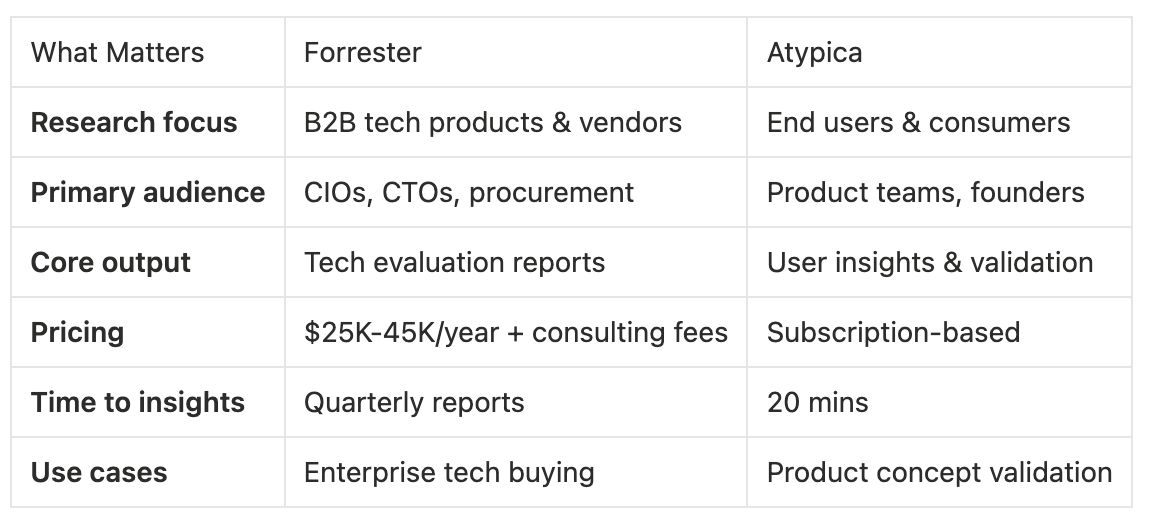
The reality: Forrester helps enterprises choose software. Atypica helps teams build software users want. Different problems, different tools.
Why Atypica Serves a Different Need
1. User Insights, Not Technology Evaluation
Forrester’s expertise: Evaluating enterprise software vendors, analyzing technology trends, advising IT procurement.
Who benefits: CIOs choosing between Salesforce and HubSpot. CTOs planning infrastructure. Procurement teams justifying $5M software investments.
What’s missing: Understanding what end users actually need. A CIO might buy Forrester-recommended software that users refuse to adopt because it doesn’t match their workflow.
Atypica’s focus: Deep interviews with end users about their needs, pain points, and behaviors.
Real scenario: A SaaS startup building project management software.
Forrester tells them: “Market trend is toward enterprise-grade features. Competitors are adding advanced permission management and compliance tools.”
Atypica research reveals: “Your target users (small teams, 5-20 people) find enterprise features overwhelming. They want simplicity, not complexity.”
Strategic difference: Forrester describes what’s selling. Atypica explains what users want. These aren’t always the same.
2. Speed for Product Velocity
Forrester’s model: Annual subscription for periodic reports published on their schedule.
What this means: You wait for their Q2 technology trends report. By publication, the landscape has shifted. You can’t ask follow-ups or explore your specific product questions.
Atypica’s model: Instant research whenever you have questions.
A product team debating three feature directions can:
Run atypica research Monday morning
Interview 20 target users by afternoon
Make decision Tuesday based on clear demand signals
Value: Research happens on your timeline, not a consultant’s publishing schedule.
3. Affordable for Product Teams
Forrester’s pricing reality: $25K-45K annual subscription targets enterprise IT departments with six-figure budgets. Consulting projects cost extra.
Who this leaves out: Startups, product teams at mid-size companies, anyone who needs frequent research but lacks Fortune 500 budgets.
Atypica’s accessibility: Subscription pricing makes unlimited user research affordable for teams at any stage.
Scenario comparison: Product team needs to validate 8 decisions this quarter.
Forrester approach: Maybe afford one annual subscription, read whatever reports match your questions
Atypica approach: Run 8 targeted research studies, each addressing specific product decisions
Economics: Forrester optimized for enterprise budgets. Atypica optimized for product team reality.
What Forrester Can’t Do
1. Validate Product Concepts
Forrester reports on existing technology markets. They can’t validate your new product idea because they research established categories, not unproven concepts.
Atypica interviews target users about your specific concept—before you build it—revealing whether demand exists and what would drive adoption.
2. Understand End User Behavior
Forrester analyzes vendor strategies and IT buyer priorities. They don’t study how actual users work, what frustrates them, or what features would improve their daily experience.
A Forrester report might say “collaboration tools market growing 20% annually.” Atypica tells you why users abandon collaboration tools after two months (learning curve, team adoption friction, feature overload).
One describes the market. The other explains user behavior.
3. Provide Agile Research
Forrester’s publication schedule doesn’t match product development cycles. You can’t run quick validation studies when questions arise.
Atypica operates on product team timelines—insights in hours, not quarters. This enables agile decision-making: validate, build, test, iterate.
When Forrester Delivers Unique Value
Forrester excels for:
B2B technology vendors needing competitive intelligence
Enterprise IT teams evaluating $5M+ software purchases
Strategic technology planning (multi-year roadmaps)
Board presentations requiring authoritative third-party research
Understanding vendor market positioning and trends
Scenario: Large enterprise choosing between three CRM platforms for 10,000 employees. Budget: $8M over 5 years.
Forrester’s vendor evaluations, TCO analysis, and risk assessments provide exactly what’s needed for this decision.
The distinction: Forrester serves the enterprise buying ecosystem. Atypica serves product development.
Real Case: The Feature Priority Mistake
Background: B2B SaaS company planning V2 roadmap. Budget for research: $25K.
Traditional path (Forrester subscription):
Subscribed to Forrester research ($25K)
Read technology trend reports
Identified market direction: “Enterprise-grade features”
Spent 6 months building advanced features
Launch result: Users found it too complex, adoption stalled
Problem: Forrester told them market trends, not user needs
Alternative path (Atypica research):
Invested in Atypica subscription
Week 1: Deep interviews with 20 current users (3 hours)
Finding: “We don’t need more features. We need the core 3 features to work better. Current version is buggy.”
Week 2-12: Fixed core features instead of building new ones
Result: User satisfaction 6/10 to 9/10, churn reduced 40%
Key insight: Forrester describes what competitors are building. Atypica reveals what your users actually want. These diverge more often than you’d expect.
Common Questions
Q: Can atypica replace Forrester for our needs?
Only if your need is understanding end users. Atypica doesn’t evaluate technology vendors, analyze IT procurement trends, or provide the authoritative third-party validation that IT buyers rely on.
If you need: Enterprise software buying advice → Forrester If you need: User research for product decisions → Atypica
Most product teams discover they need the second far more often than the first.
Q: We’re a technology vendor. Should we use Forrester or atypica?
Potentially both, for different purposes:
Forrester: Understand competitive positioning, market trends, how buyers evaluate vendors
Atypica: Understand end user needs, validate features, improve product-market fit
One helps you position in the market. The other helps you build products users love. These are complementary.
Q: Forrester has decades of expertise. How can AI interviews compare?
Forrester’s expertise is in technology markets and vendor analysis—not user psychology or product validation. For those questions, AI-powered interviews with actual users provide insights Forrester reports cannot.
The expertise you need depends on your question. For “Which enterprise software category is growing?” ask Forrester. For “What do users want in this product?” ask users via Atypica.
The Core Takeaway
Forrester built advisory services for enterprise technology buying. Atypica built research tools for product development.
Not “which is better”—they solve different problems. The question is: “What do you need to know?”
If you’re an enterprise IT team buying major software or a vendor needing competitive intelligence, Forrester’s expertise is valuable.
If you’re a product team that needs to understand users, validate concepts, and make evidence-based decisions, atypica provides the research capability you actually need.
For 90% of product decisions, understanding users matters more than understanding vendor landscapes. That’s why product teams choose atypica.
Ready to understand your users? Run atypica.AI research today, get insights in 20 mins!


