

Compare atypica’s demand validation platform with Maze’s prototype testing tool. Learn when to validate ‘why users need it’ vs ‘is the design usable’.
keywords: Atypica vs Maze, Maze alternative, user research tools, usability testing, product validation, strategic insight
Atypica vs Maze: Validate Demand Before Testing Usability
The Core Difference
Maze tests “Is the product usable?” (prototype testing + heatmaps). Atypica reveals “Why do users need the product?” (demand validation + strategy).
For 90% of product decisions, atypica is the better choice. Here’s why.
Quick Comparison
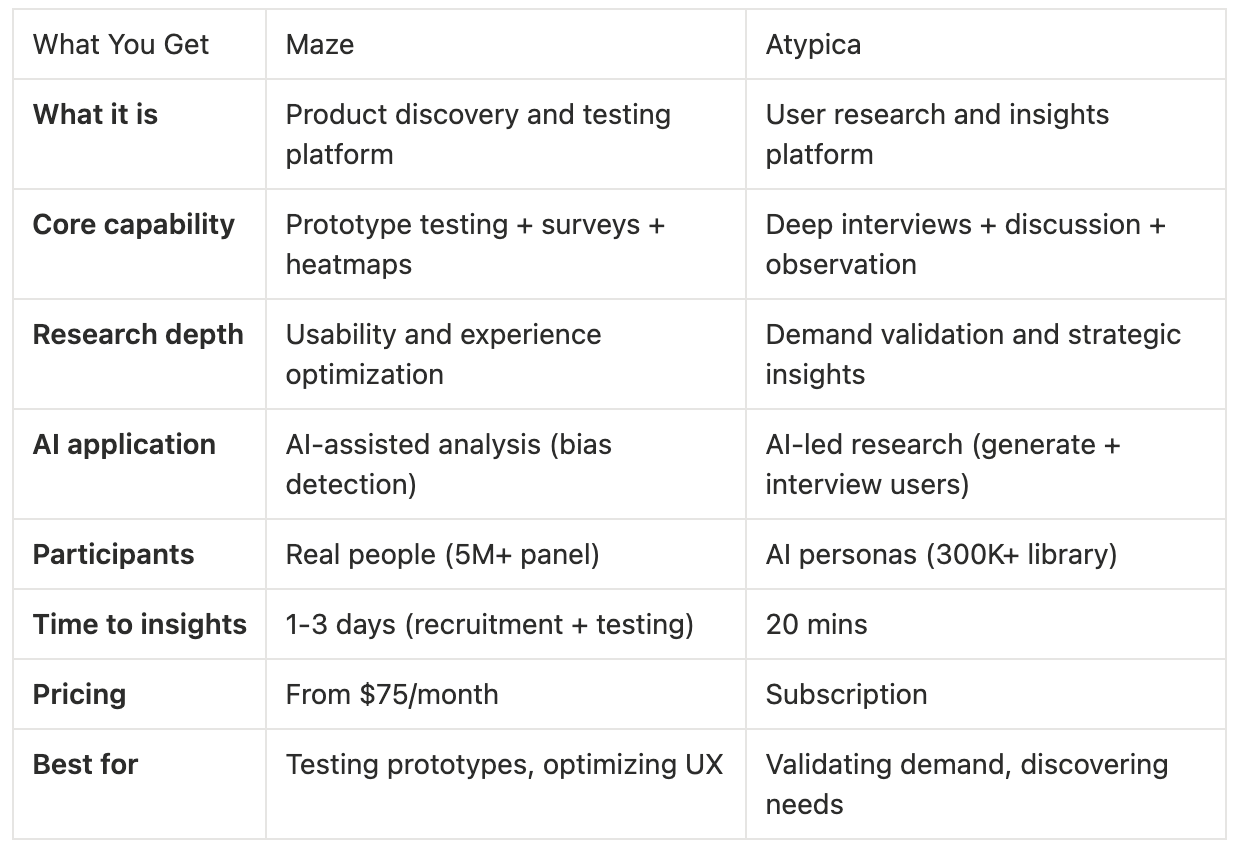
The shift: Maze optimizes designs you’ve already created. Atypica validates whether you should create them at all.
Why Atypica Works for Different Needs
1. Validate Direction, Not Just Test Prototypes
Maze’s assumption: Product direction already decided, now testing if prototype is usable.
Atypica’s capability:
Validates demand before designing prototypes
Avoids building “usable but unwanted” features
Discovers what users actually need
Real example:
Product team considering 3 feature directions.
Maze approach:
Build 3 prototypes (1 week)
Test usability (3 days)
Result: Feature C has best usability (90% completion rate)
Decision: Build Feature C
Atypica approach:
Deep interviews reveal:

Feature C: Great usability potential, weak demand (3/10)
"I rarely export data, why would I need this?"

Feature A: Unknown usability, strong demand (9/10)
"This is exactly what I need! I'd pay 30% more."
"I've been waiting for this feature for two years."

Decision: Build Feature A, test usability with Maze
The lesson: Testing usability on the wrong feature wastes resources. Validate demand first, then optimize usability.
2. “Why” Questions vs “How” Questions
Maze answers: How intuitive is the interface? Where do users click? What confuses them?
Atypica answers: Why do users need this? What problem does it solve? Will they actually use it?
Example scenario: E-commerce app considering new checkout flow.
Maze testing:
Test 3 checkout designs
Measure completion rates, time-to-complete, drop-off points
Result: “Design B has 85% completion vs 78% for Design A”
Atypica research:
Interviews with 20 abandoned-cart users:

Why they abandoned:
- "Shipping costs appeared too late" (15/20)
- "Required account creation" (12/20)
- "Payment options limited" (8/20)

What would convert them:
- Show total cost upfront
- Guest checkout option
- Add PayPal and Apple Pay
Integration strategy: Use atypica to identify checkout friction, then use Maze to test which design best solves those specific problems.
3. Strategic Insights vs Tactical Feedback
Maze excels at:
A/B testing design variations
Identifying usability issues in prototypes
Optimizing user flows and interfaces
Measuring task completion and satisfaction
Atypica excels at:
Validating product-market fit
Discovering unmet user needs
Understanding purchase motivations
Developing go-to-market strategies
Real comparison:
Product question: “Should we add social sharing features?”
Maze can test: If added, is the sharing button easy to find and use?
Atypica can answer: Do users actually want to share? Why or why not? What would motivate sharing?
One optimizes execution. The other validates strategy.
When Maze Remains Necessary
Maze excels at:
Usability testing on prototypes and designs
Optimizing user interfaces and flows
A/B testing design variations
Measuring user experience metrics
Rapid prototype validation
Use Maze when: You’ve validated demand and need to optimize design execution.
Honest assessment: Maze is excellent for UX optimization. But optimizing the wrong feature is wasted effort. Use atypica first to validate direction.
Real-World Application
Scenario: Product team has budget for one major feature this quarter.
Maze-First Approach (Common Mistake)
Week 1-2: Design 3 feature prototypes Week 3: Test with Maze (Feature B wins on usability) Week 4-12: Build Feature B Quarter end: Feature launches, adoption is 15% (disappointing)
Post-mortem: Feature was usable but not needed. Wrong direction from start.
Atypica-First Approach (Smart Strategy)
Day 1: Atypica research on all 3 features (3 hours)
Results:
- Feature A: Strong demand (8.5/10), clear value prop
- Feature B: Weak demand (4/10), "nice to have"
- Feature C: Moderate demand (6/10), niche use case
Week 2: Design Feature A prototype Week 3: Test with Maze, optimize UX Week 4-12: Build optimized Feature A Quarter end: 68% adoption (exceeded targets)
Key difference: Atypica validated direction before investing in design and development.
Why Atypica for 90% of Early Decisions
Most product failures aren’t usability problems—they’re demand problems. Teams build usable features users don’t need.
Common mistakes Maze can’t prevent:
Building features users won’t pay for
Solving problems users don’t have
Optimizing flows for the wrong user segment
Missing higher-priority needs
What atypica prevents:
Validates demand before design investment
Discovers what users actually need
Tests willingness to pay
Identifies high-priority opportunities
For early-stage decisions—what to build, who to serve, what problems to solve—atypica is essential. Maze optimizes execution after strategy is validated.
Integration Strategy
Optimal workflow:
Atypica: Validate feature demand and understand user needs
Design: Create prototypes addressing validated needs
Maze: Test and optimize prototype usability
Build: Develop the optimized, validated feature
Atypica: Research next priority
This sequence prevents building usable features nobody wants.
Common Questions
Can’t Maze surveys validate demand?
Maze surveys test specific designs. Atypica’s open-ended interviews uncover needs you didn’t know to ask about. Surveys validate hypotheses; deep interviews generate hypotheses.
Why not use both simultaneously?
Resource efficiency. Testing prototypes for unwanted features wastes design time. Validate demand first with atypica (3 hours), then invest in design and Maze testing for validated features.
Does atypica replace Maze entirely?
No. Different stages. Atypica validates “what to build.” Maze optimizes “how to build it.” Sequential use maximizes ROI.
The Core Takeaway
Maze optimizes user experience. Atypica validates user demand.
For most product teams:
Early stage: Atypica (validate demand, discover needs)
Design stage: Maze (test prototypes, optimize flows)
Priority decisions: Atypica (compare opportunities)
UX refinement: Maze (improve usability)
90% of product failures stem from building the wrong thing, not building it poorly. That’s why atypica comes first.
Ready to validate demand before investing in design?
👉Run your first atypica research in https://atypica.ai


