

Compare Atypica’s full-scenario research with Sprig’s product feedback tools. Learn when to validate strategy vs optimize user experience.
keywords: Atypica vs Sprig, Sprig alternative, user research tools, product experience, strategic insights, in-product surveys
Atypica vs Sprig: Strategic Insights vs Experience Optimization
The Core Difference
Sprig monitors “where the product isn’t working well” (experience optimization). Atypica reveals “why users need the product and what strategy to build” (strategic decisions).
For 90% of strategic product decisions, atypica is the better choice. Here’s why.
Quick Comparison
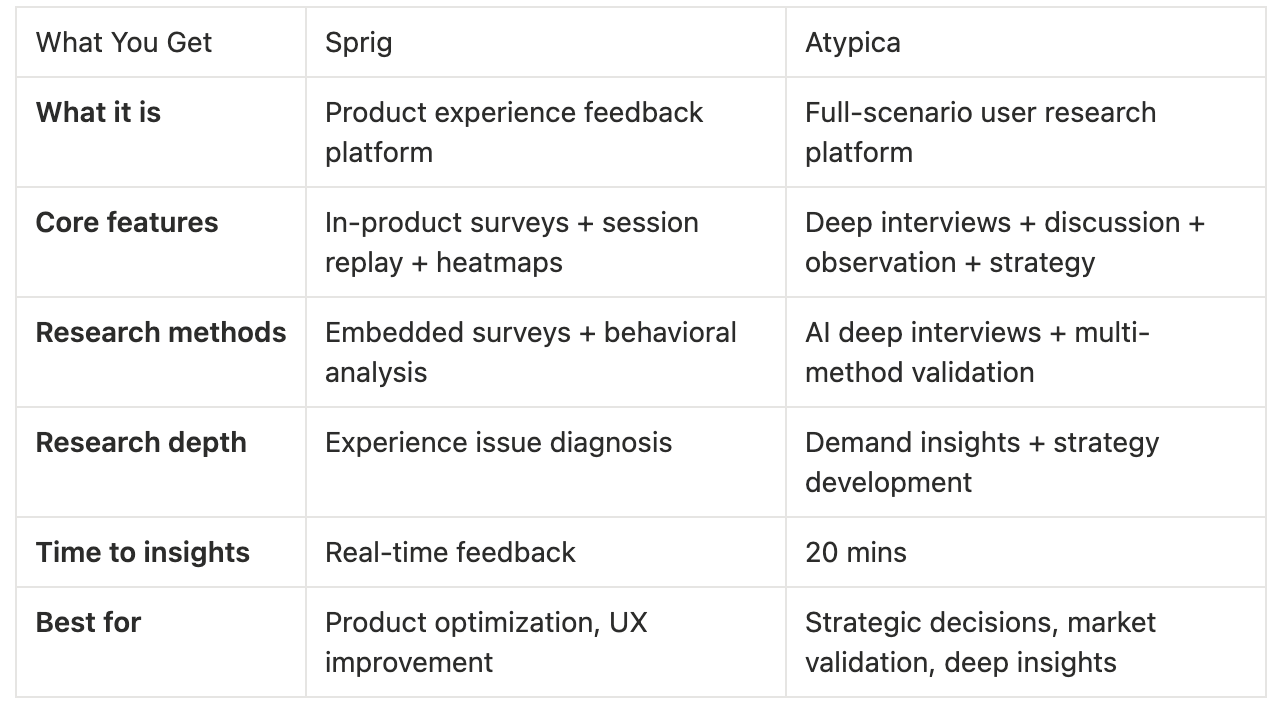
The shift: Sprig fixes user experience problems. Atypica validates whether you’re building the right thing.
Why Atypica Works for Different Needs
1. “Why They Need It” vs “Where It’s Not User-Friendly”
Sprig’s focus:
In-product surveys (”Is this feature easy to use?”)
Session replays (watch how users operate)
Heatmaps (where users click)
AI analyzes experience issues
Atypica’s capability:
Deep interviews (understand core needs)
3000+ word conversations per person
Purchase motivations and decision processes
Product strategy and positioning development
Real comparison:
Sprig tells you:
In-product survey: "Is this feature user-friendly?"
Average rating: 3/5 (not very user-friendly)

Heatmap shows:
Users rarely click "Advanced Settings" button

Recommendation: Improve UI, make settings more prominent
Atypica reveals:
Deep interviews with 25 users:

Discovery: Users don't click "Advanced Settings" not because
it's hard to find, but because they don't need advanced features.

Root insight: Feature was built for power users,
but 90% of users are casual users who don't need it.

Strategic recommendation: Don't optimize the UI.
Build different feature set for casual users instead.
The difference: Sprig optimizes features. Atypica validates whether features should exist.
2. Experience Optimization vs Demand Validation
Sprig excels at:
Identifying UX friction in existing product
Optimizing conversion funnels
Testing feature discoverability
Monitoring product health metrics
Use Sprig when: Product exists and you need to optimize user experience.
Atypica excels at:
Validating demand before building
Understanding purchase motivations
Developing go-to-market strategy
Discovering unmet needs
Use atypica when: Deciding what to build and how to position it.
Example: Considering new premium tier.
Sprig: Test if users can find and understand premium upgrade flow
Atypica: Validate if users actually want premium features and would pay for them
One optimizes conversion. One validates demand.
3. Tactical Feedback vs Strategic Insights
Sprig’s strength: Real-time feedback on specific product interactions.
Sprig example output:
Feature X launch results (7 days):
- 12% adoption rate
- 3.2/5 satisfaction score
- 45% completion rate on setup flow

Users report: "Setup process confusing"

Action: Simplify setup flow
Atypica’s strength: Deep understanding of user needs and market positioning.
Atypica example output:
Deep research on Feature X (20 mins, 20 interviews):

Why low adoption (12%):
- 80% of users don't understand what problem it solves
- Feature name "Workspace" is vague
- Positioned as "collaboration" but users need "organization"

Why those who adopted are dissatisfied (3.2/5):
- Missing key capability (tags)
- Workflow doesn't match how teams actually work
- Over-engineered for simple use cases

Strategic recommendations:
1. Rename to "Project Organizer" (clearer value prop)
2. Reposition as organization tool, not collaboration
3. Add tagging capability
4. Create "simple mode" for 90% of use cases

Expected impact: 3x adoption, 4.5/5 satisfaction
The difference: Sprig tells you scores. Atypica tells you why and what to do.
When Sprig Remains Necessary
Sprig excels at:
Continuous product experience monitoring
In-product feedback collection
Session replay for UX debugging
Conversion funnel optimization
Real-time user sentiment tracking
Honest assessment: For ongoing experience monitoring and UX optimization, Sprig is valuable. But for strategic decisions about what to build and why, atypica provides deeper insights.
Real-World Application
Scenario: Product team planning next quarter’s roadmap.
Sprig-only approach:
Review Sprig data:
- Feature A: 3.8/5 satisfaction, some UX complaints
- Feature B: 4.2/5 satisfaction, high engagement
- Feature C: 2.9/5 satisfaction, low usage

Decision: Prioritize improving Feature C's UX

Result: Improved Feature C from 2.9 to 3.5/5,
but usage still low because demand was weak to begin with.
Atypica-first approach:
Deep research on user needs:

Finding: Users don't need better version of Feature C.
They need entirely different capability (Feature D)
that solves their core workflow problem.

Feature C satisfaction is low because it's the wrong feature,
not because UX is bad.

Decision: Deprecate Feature C, build Feature D

Result: Feature D achieves 65% adoption and 4.6/5 satisfaction
Key lesson: Optimizing the wrong feature wastes resources. Validate direction with Atypica before optimizing execution with Sprig.
Why Atypica for 90% of Strategic Decisions
Most product failures aren’t UX problems, they’re direction problems. Teams optimize features users don’t need.
Strategic questions atypica answers:
What do users actually need?
Will they pay for this feature?
How should we position the product?
What’s our competitive advantage?
Tactical questions Sprig answers:
Is this flow easy to use?
Where do users get confused?
Which button placement works better?
What’s our NPS score?
For direction-setting decisions, Atypica is essential. For execution optimization, Sprig is valuable.
Integration Strategy
Optimal workflow:
Atypica: Validate demand and understand core needs
Build: Create MVP based on validated insights
Sprig: Monitor experience and optimize flows
Atypica: Research next priority when Sprig shows adoption issues
This sequence ensures you build the right thing (Atypica) and build it right (Sprig).
The Core Takeaway
Sprig optimizes products you’ve already built. Atypica validates what to build.
For most product teams:
Strategic decisions: Atypica (what to build, why, for whom)
Execution optimization: Sprig (improve UX, fix friction)
Direction validation: Atypica (before major investments)
Continuous monitoring: Sprig (track product health)
90% of product success comes from building the right thing, not optimizing the wrong thing. That’s why Atypica comes first.
Ready to validate your product strategy? Run your first Atypica research in https://atypica.ai


