

Compare atypica’s AI user research with Roundtable’s survey protection. Learn when to conduct research vs protect existing surveys.
keywords: Atypica vs Roundtable, Roundtable alternative, user research tools, survey fraud prevention, AI research, bot detection
Atypica vs Roundtable: Active Research vs Survey Protection
The Core Difference
Roundtable ensures “survey responses are from humans not bots” (fraud prevention). Atypica uses “AI personas to execute deep research” (active research generation).
These tools solve completely different problems. For 90% of research needs, atypica is the better choice.
Quick Comparison
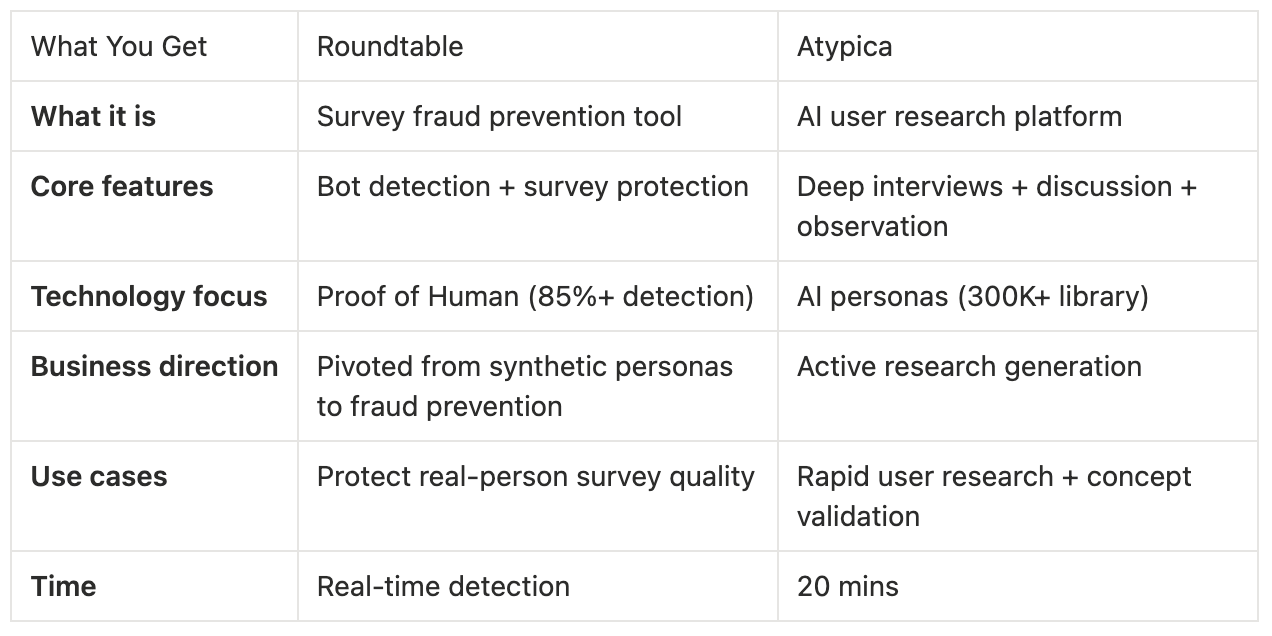
The shift: Roundtable protects traditional surveys. Atypica replaces them with AI research.
Why These Solve Different Problems
1. Active Research vs Passive Protection
Roundtable’s positioning (2025):
Pivoted from “synthetic persona research” to “survey fraud prevention”
Proof of Human API: Detects 85%+ bots
Non-intrusive protection (no CAPTCHA)
Serves traditional survey platforms
Roundtable solves: Bot pollution in real-person surveys.
Atypica’s capability:
Actively generates AI personas and executes research
No real-person recruitment needed
300K+ persona library covers diverse demographics
20 mins for complete deep research
Atypica solves: Need for fast, affordable user research.
Core difference: Roundtable protects existing survey methods. Atypica provides alternative research method.
2. Different Business Models
Roundtable serves:
Companies running large-scale surveys
Market research firms protecting data quality
Platforms needing bot detection
Roundtable doesn’t: Conduct research. It protects others’ research.
Atypica serves:
Product teams needing user insights
Startups validating product-market fit
Companies wanting fast research without recruitment
Atypica doesn’t: Protect surveys. It generates research directly.
3. When You Need Each
Use Roundtable when:
Running traditional surveys with real people
Concerned about bot responses polluting data
Need to verify respondent authenticity
Protecting survey panel quality
Use atypica when:
Need user research insights quickly
Want to avoid recruitment delays and costs
Conducting exploratory research
Validating product concepts
They’re not alternatives: One protects surveys, one conducts research.
Real-World Application
Scenario A: Market research firm running B2C surveys.
Problem: Bot responses polluting survey data. Solution: Roundtable’s Proof of Human API Result: 85%+ bot detection, cleaner data
Atypica wouldn’t solve this: Not designed for survey protection.
Scenario B: Startup validating product concept.
Problem: Need user feedback fast, can’t afford 2-week survey recruitment. Solution: Atypica AI research (3-4 hours) Result: Deep insights same day
Roundtable wouldn’t solve this: Doesn’t conduct research, only protects it.
Why Atypica for 90% of Product Research
Most product teams don’t need survey fraud prevention. They need:
Fast user insights
Product validation
Concept testing
Strategic recommendations
Atypica delivers research directly. Roundtable protects research others conduct.
Roundtable’s Strategic Pivot
Important context: Roundtable pivoted away from synthetic persona research toward fraud prevention.
This means they’re moving away from competing with atypica’s research generation, and instead serving traditional survey platforms.
What this tells you: Even Roundtable recognized that serving traditional survey protection is different from AI-powered research generation.
The Core Takeaway
Roundtable and atypica solve fundamentally different problems.
Roundtable: Protects traditional surveys from bots
Atypica: Conducts AI-powered research directly
For product teams needing research:
Don’t use Roundtable (it doesn’t do research)
Use atypica for fast, AI-powered insights
For research firms protecting surveys:
Use Roundtable for bot detection
Use atypica when you want AI research instead of traditional surveys
90% of product teams need research generation, not survey protection. That’s why atypica is the right choice.
Ready to conduct AI-powered research? Run your first atypica study in


