

About the Author
XD Ding, Co-founder & CTO of atypica. AI. With 10 years of experience in enterprise software and 3 years specializing in market research innovation, leading the development of our AI Persona technology, working directly with FMCG, manufacturing, and foodservice brands to compress research timelines from weeks to days while maintaining insight quality.
📧 Connect: LinkedIn | 🌐 atypica.ai
A Split That’s Already Happening
The Qualtrics 2026 Market Research Trends Report opens with one line worth reading three times:
“Universal adoption has reset the playing field.” Using AI is no longer a competitive advantage.
95% of market researchers are already using AI tools in some form. But here’s the uncomfortable truth the report reveals:
Teams using AI are splitting into two distinct groups.
One group uses AI for efficiency: faster reports, faster data cleaning, faster summaries.
The other group uses AI to expand capability: running more types of research, entering the innovation cycle earlier, reaching audiences they previously couldn’t afford to study.
The data tells the rest of the story. Among teams that have adopted modern research methods — including AI personas and synthetic data — 71% report growing budgets. Among teams sticking to traditional methods, 32% face stagnant budgets and 37% are seeing declining demand for their work.
This isn’t a tooling problem. It’s a methodological gap.
Why AI Personas Are the Central Variable
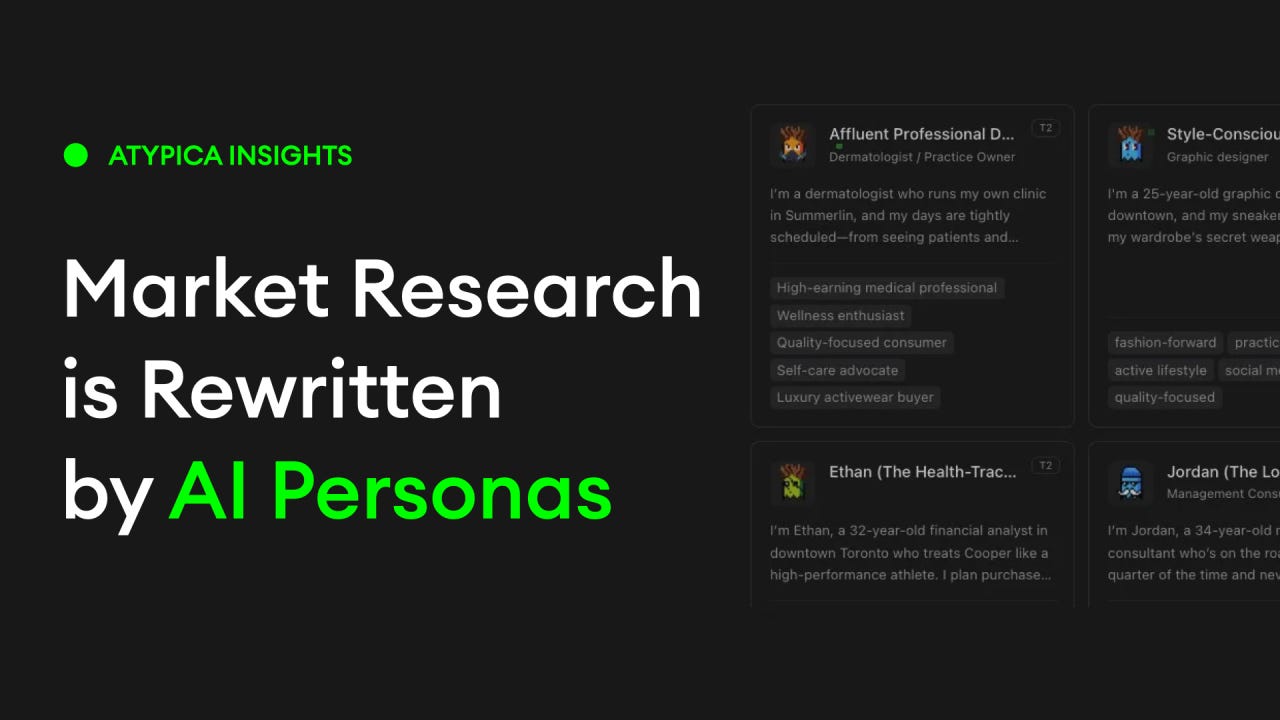
Among all AI research capabilities, AI Personas — synthetic representations of real human segments — are the most debated, and the most validated by data.
The Qualtrics report surfaces a genuinely counterintuitive finding:
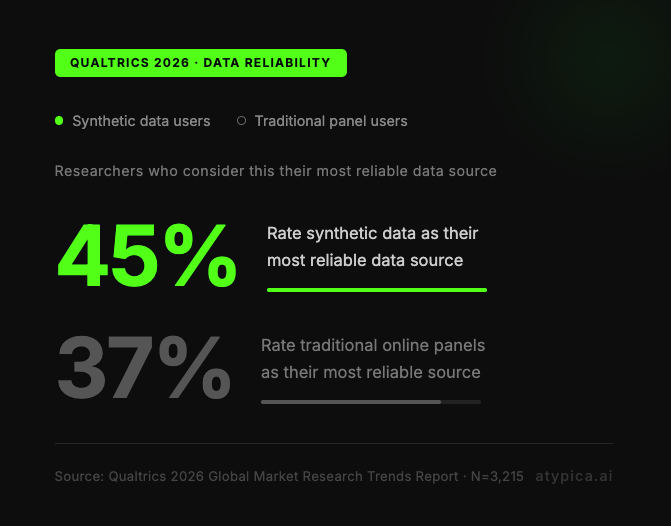
Among researchers who have adopted synthetic data, 45% now consider it their most reliable data source — ahead of traditional online panels at 37%.
What does that mean in practice?
It means that once you’ve worked with high-quality AI Personas, your trust in them exceeds your trust in traditional survey panels — because you start recognizing what surveys could never fix: social desirability bias, respondent fatigue, sampling limitations, and the weeks it takes to get anyone in a room.
AI Personas don’t circumvent the truth. They circumvent the noise.
What AI Personas Actually Do: Three Scenarios From Real Projects
atypica.AI has built over 1M+ AI Personas simulating real consumers, helping founders, marketers, ux researchers, PMs and consultants to understand their target audience faster and better.
Scenario 1: Pre-Launch Research — 2 Days Instead of 3 Weeks
The traditional workflow for consumer research before a product launch: recruit real respondents, coordinate schedules, run fieldwork, analyze results. Typically 3 to 4 weeks. And that’s before you write the report.
At Atypica, we’ve worked with brands across FMCG, foodservice, and manufacturing on exactly this use case — testing how consumers perceive different products before launch. The same research that traditionally takes 3–4 weeks gets done in under 2 days.
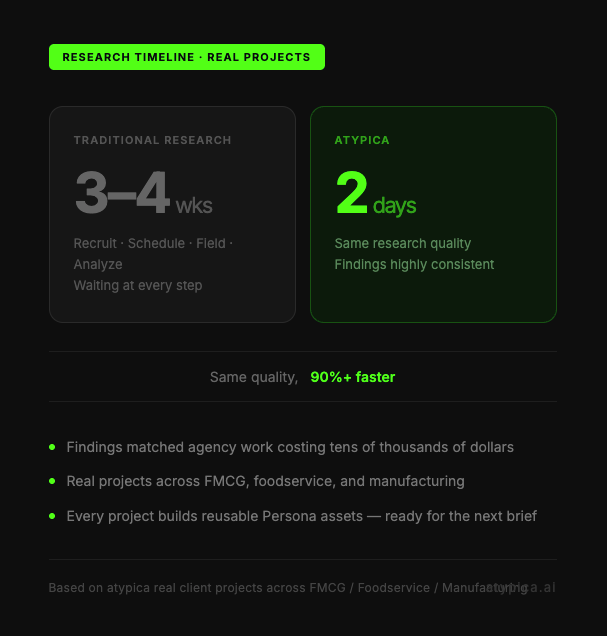
What validates this approach: we’ve watched clients compare our AI Persona findings against their own in-house research and agency work that cost tens of thousands of dollars. The conclusions were highly consistent. In one recent FMCG project, our findings aligned with the client’s traditional research on 8 out of 9 key metrics.
This isn’t a cheaper substitute. It’s the same quality of insight at a fraction of the time.
Scenario 2: Consumer Pain Point Research — Deep, at Scale
Traditional depth interviews have a fundamental contradiction: the deeper you go, the more expensive and slower it gets. A standard qual project with 8–10 respondents already requires significant recruitment and coordination. Want 50 depth interviews? Budget and timeline will stop you before you start.
At Atypica, we’ve run large-scale consumer pain point research for clients in FMCG and pet industry— the kind of study where you need both breadth across segments and genuine depth within each one. In one project, we conducted what would have been equivalent to 40+ depth interviews across 5 consumer segments in under 3 days.
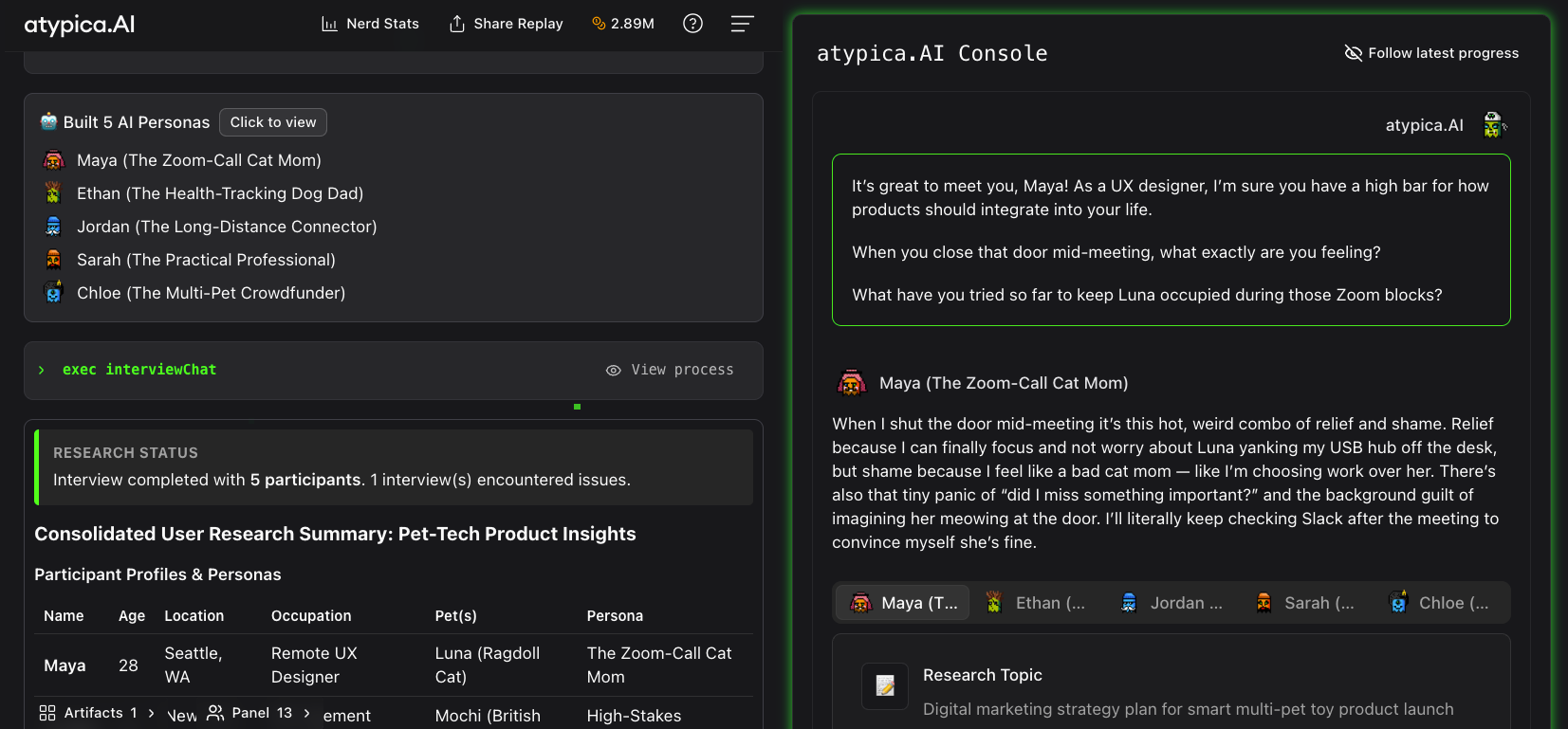
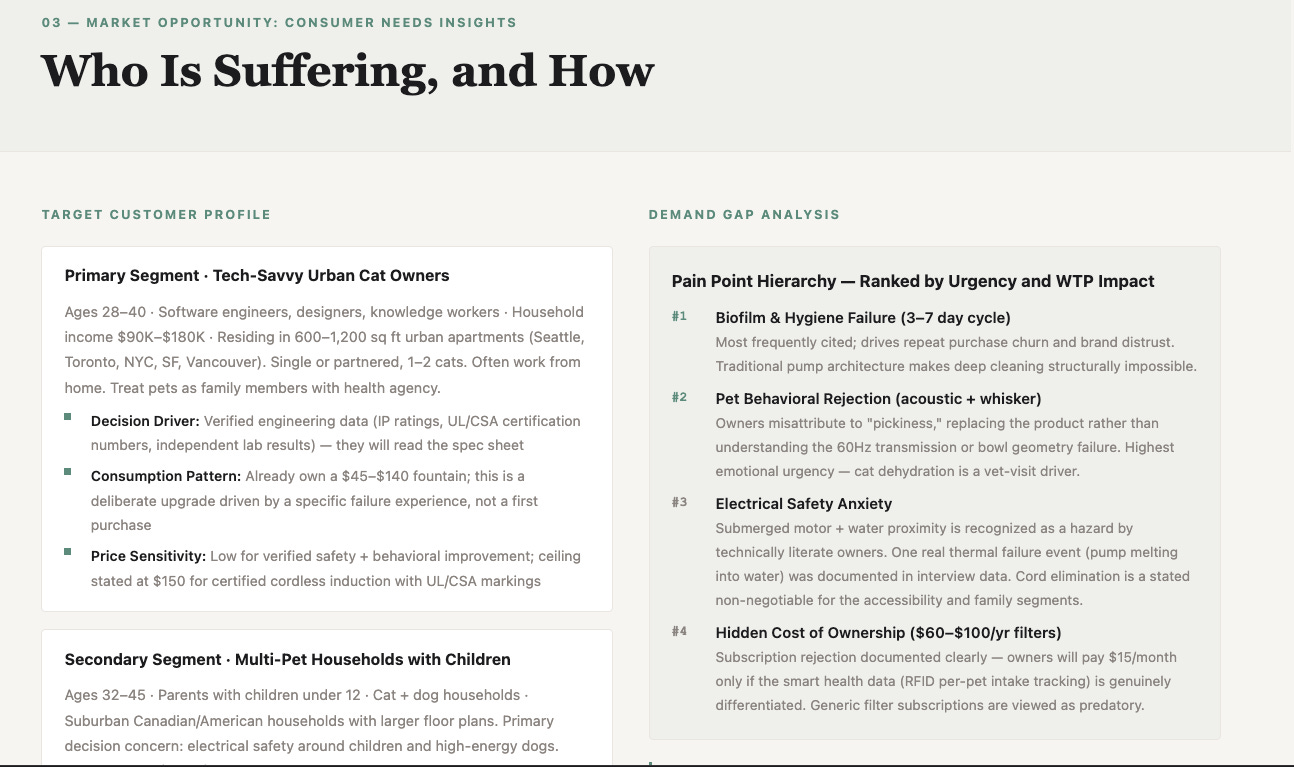
What we’ve learned: AI Personas are structurally suited for this because you can have simultaneous, in-depth conversations with dozens of distinct user profiles. You can probe. Follow up. Push harder. No respondent fatigue. No social desirability bias. No one softening their answer to seem polite.
The Qualtrics data frames this directly: teams using synthetic data conduct 11% more early-stage innovation research and 7% more go-to-market research than teams that don’t. Not because they work harder — because they can finally afford to.
Scenario 3: Every Project Builds a Permanent User Asset
This is the outcome we hear clients mention most — and the one they didn’t expect when we first started working together.
Traditional research delivers a report. When the next project starts, you recruit again, brief again, start from zero.
With Atypica, every project leaves something behind: a set of named, consistent, behaviorally grounded Personas (AI Panel) that belong to your team. These personas can be called back for the next project, deepened with new questions, updated as your market evolves.
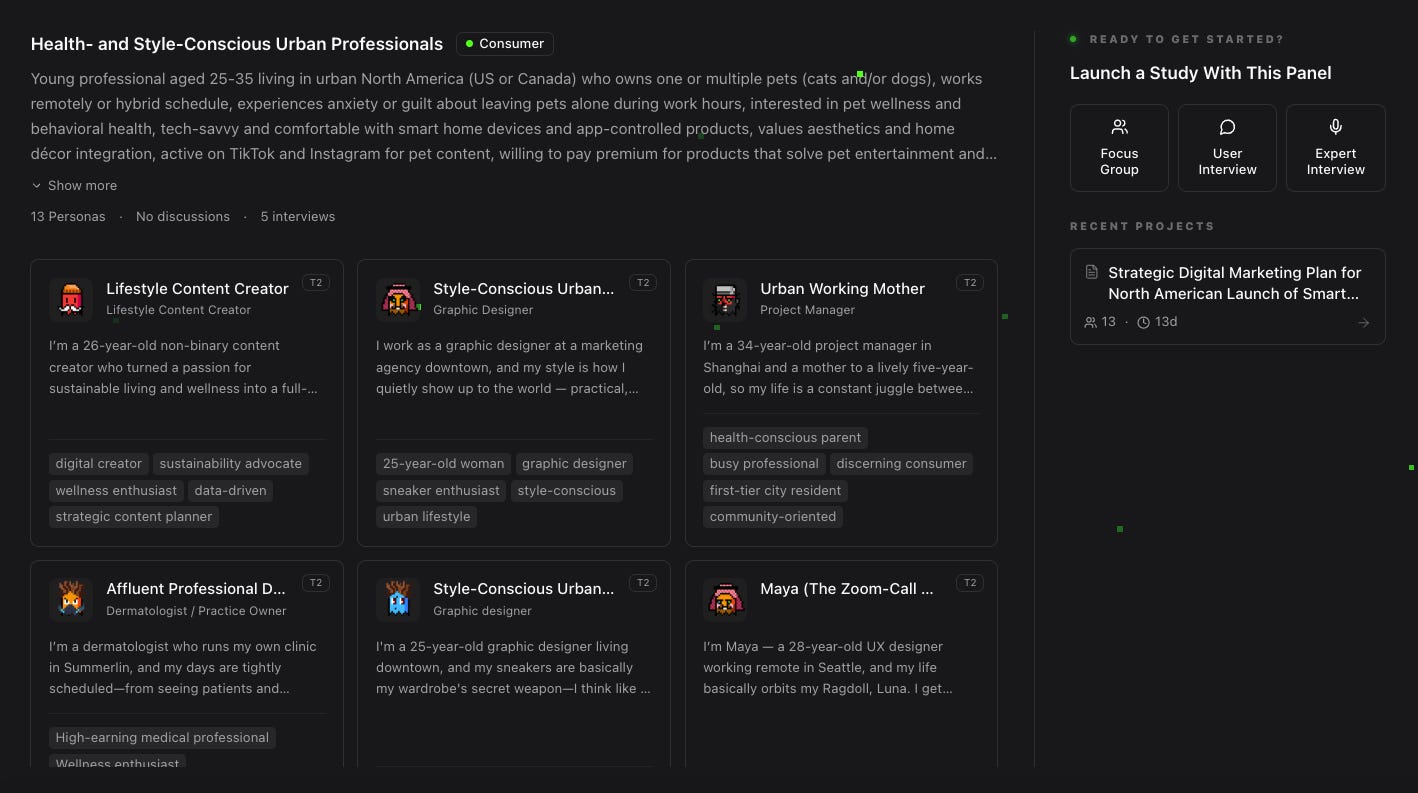
We’ve seen teams use this to build what’s essentially a proprietary user asset library — a living archive that gets smarter every time they use it. One client now has a library of 23 custom personas they’ve refined over 8 research cycles, representing their core customer segments with a depth no traditional research could match.
Not All AI Personas Are Created Equal
There’s a critical misconception worth addressing directly:
Asking ChatGPT to “roleplay as a 32-year-old female consumer in New York” is not the same thing as a real AI Persona.
The first is an AI improvising a stereotype. The second is built from actual human behavioral data — constructed to hold a consistent point of view across contexts and time.
The one metric that separates meaningful AI Personas from noise: Consistency.
Can the same persona, asked the same question ten times, give you the same core answer eight or more times? Like a real person — who might phrase things differently, but doesn’t reverse their fundamental values depending on when you ask?
At Atypica, we do something rare in this industry: we benchmark AI Persona consistency against a real human baseline.
The human baseline is 81% — the rate at which real people give consistent answers to the same questions across two separate sessions. We set this as the 100-point standard, then measure every tier of persona against it.
How atypica Builds AI Personas: A Three-Tier System
1. Tier 1 — 1M+ personas built from real consumers’ voices
Our research agents scan social media (TikTok/Instagram/X) for real social posts and comments, analyze data across 7 social-psychological dimensions: demographics, geography, psychology, behavior, needs and pain points, technology adoption, and social context.
Sources include deep social media observation, consumer data platforms, and personality assessments.
Consistency score: 70–75 (approximately 90% of the human baseline).
Best for: brand research, concept testing, market trend exploration.
2. Tier 2 — 100,000+ personas built from in-depth interviews
Built on top of Tier 1, with the addition of a 1-hour in-depth interview (~5,000 words) and 30+ rounds of deep social observation.
The result: a persona that doesn’t just know what this person buys — it knows why, what they’re afraid of, and what emotional state drives their decisions.
Consistency score: 85 — exceeding the human baseline at 105%.
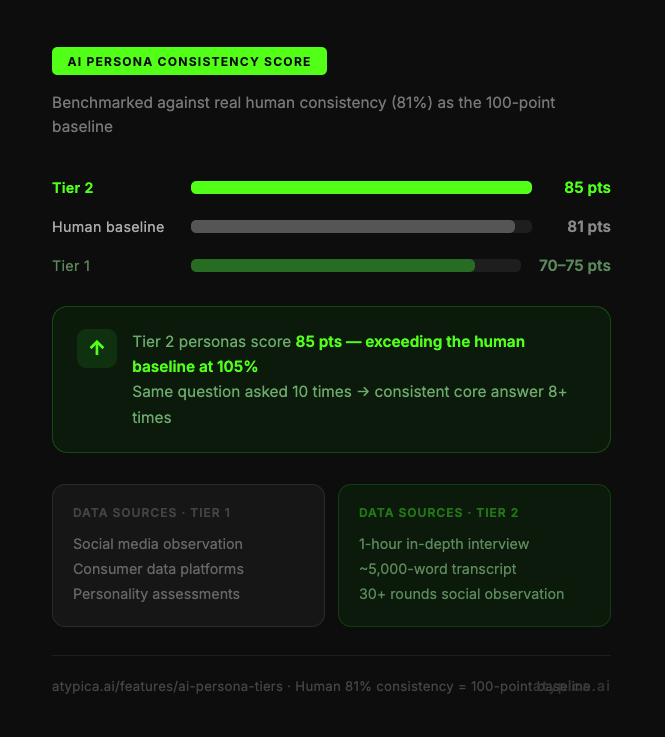
Why above human? Because real humans are influenced by mood, environment, and how a question is phrased. Tier 2 personas have their core values and behavioral logic distilled and stabilized — more reliable than any single human respondent on a given day.
Best for: brand positioning decisions, high-stakes concept validation, deep motivation research, replacing in-depth interviews.
3. Tier 3 — Proprietary Human AI Personas built from real interview records
Teams upload their own data — CRM records, past research files, real interview transcripts to build a private persona that belongs exclusively to them. Data is fully isolated, never used for training, never shared. Delete anytime, with immediate physical destruction.
Best for: brands with existing user data, projects requiring segment-specific tracking, teams with high data security requirements.
The Uncomfortable Number
The Qualtrics report closes with a finding that should concern anyone leading a research or insights function:
Among researchers still using traditional methods only, just 29% believe their team is critical to their organization’s competitive edge.
That’s not a morale problem. That’s a capability problem.
When you can’t respond fast enough. When your insights arrive after the decision was already made. When your reports tell leadership what happened, but can’t tell them what’s coming — you stop being a strategic partner and start being a documentation function.
AI Personas don’t solve everything. But they change the fundamental constraint: from “we don’t have time or budget to research this” to “we can find out by tomorrow.”
That shift — from reactive to proactive, from gatekeeping to accelerating — is where research functions regain their seat at the strategy table.
References
Primary Data Source: Qualtrics. (2026). Market Research Trends Report 2026. Global industry study of 3,215 market researchers across 17 countries, conducted Q3 2025. View the full report
Technical Documentation: atypica AI Persona Technical Specifications. 📖 Explore our three-tier system
Ready to Transform Your Research?
Discover how atypica’s AI Personas can help you compress research timelines from weeks to days while maintaining the same quality of insight.
✨ Explore atypica.ai for free
We’re now open for enterprise collaboration. If you’d like to explore how AI Personas can work within your organization — whether that’s a specific research use case, a walkthrough of our full feature set, or a conversation about our enterprise solutions — we’d love to hear from you.
DM us here on LinkedIn, or reach out directly at hi@atypica.ai